




































The AI Trap in Mainframe Modernization – And the Only Way Out.
By Vazi Okhandiar, VP Engineering, AI Center of Excellent (COE) mLogica
Let me start with a number that should give every CIO pause when considering a Mainframe Exit Program: 70 percent.
That is Gartner’s April 2026 finding: 70 percent of mainframe exit projects initiated this year will fail to produce their intended benefits. Gartner defines failure broadly and appropriately as the inability to meet migration objectives, performance & throughput degradation, compliance gaps, and business continuity risks.
The paper is titled Too Big to Fail: Why Mainframe Exit Projects Are Likely to Fail in the Age of Generative AI. Their warning is clear:
"Poor decision making regarding migration is not merely a budgetary overage; it is a threat to business and operational continuity."
Gartner — Too Big to Fail: Why Mainframe Exit Projects Are
Likely to Fail in the Age of Generative AI," 8 April 2026
What’s striking is not the number. It’s how familiar it is. For over two decades, mainframe exit programs have failed at high rates. What changes is the technology being promoted as the solution. What does not change is the outcome. Yet, hundreds of customers have successfully exited their Mainframes. Our largest customer in Europe migrated 54,000 MIPS workload and have been successfully running on our LIBER*M platform in a Linux environment.
A Twenty-Five Year Pattern of Failure
Before examining the specific problem with generative AI in mainframe modernization, it is worth understanding the failure pattern it is entering.
Era 1 – 2000–2015 – The big-bang rewrite or reimagine era: ~90% failure on first attempt
The industry pursued large-scale rewrites and reimagination efforts.
While customers have been successful with other journey options such as Rehosting or Re-platforming, Refactoring and Optimization of Mainframe workloads, Industry reports and Gartner analysts: nine in ten rewrite or reimagine projects do not succeed. Skills gaps, undocumented business logic, and underestimated complexity are the primary causes.
A well-known example is TSB Bank in UK (2018). Their three-year migration project included 85 subcontractors. Despite governance, multiple board reviews and third-party audits, the program failed on day one. 5.2 million customers were impacted. They received 225,000 complaints and $62M in regulatory fines. In this case, the CEO resigned.
According to Forrester, 2024, 51% of enterprises tried to rewrite mainframe applications at 6 or more times and still failed.
Era 2 – 2016–2023 - The cloud migration era: 67% failure rate
The promise shifted to “lift and shift to the cloud”
A 2025 independent analysis by Modernization Intel tracked 29 mainframe-to-cloud programs ranging from $3M to $45M in budget and found that upwards of 67% failed to meet their stated objectives. The breakdown is instructive: 31% were abandoned mid-project after encountering insurmountable data conversion issues; 24% completed cutover but reverted to the mainframe within 12 months due to performance degradation; and 11% became zombie projects , still not in production more than 30 months past their original deadline.
Critically, the failure rate was not distributed evenly across modernization strategies. It clustered heavily around programs that chose to reimagine (rewrite) core systems from scratch or replace them with SaaS or COTS applications. The programs that succeeded did so primarily through re-platforming or refactoring, approaches that preserve proven business logic rather than discarding it.
In 2024, a joint Forrester/Rocket Software study found that 35% of 309 global decision-makers have experienced significant loss of revenue or delayed initiatives due to ungoverned use of AI on their cloud migration project.
Era 3 – 2024–2026 - The GenAI Promise era: Gartner says 70%+ will fail again
Now the industry is betting on generative AI.
The pattern remains unchanged. The same structural problem: generic AI has no knowledge of your production estate, cannot guarantee deterministic output, and cannot certify functional equivalence before cutover.
No major MF customer confirmed in production using AI rewrite (reimagine)
Despite significant marketing, the analysts have yet to identify a major mainframe customer that has completed a full production mainframe exit using generative AI or reimagine-based rewrite. No evidence exists of deterministic, large-scale success.
The pattern is consistent: each era arrives with a compelling promise, boards approve budgets, and the structural realities of mission-critical mainframe estates assert themselves. AI has a genuine and important role in mainframe modernization. So does reimagination of specific functions and business logic.
The problem is treating either as an end-to-end exit engine for systems that took decades to build.
Why Generic AI Alone Cannot Solve This Problem
The appeal of generative AI for mainframe modernization is real. These models can analyze COBOL, map complex dependencies, generate documentation, and even produce refactored code at a speed far beyond what human can achieve. Boards took notice, and investment quickly followed.
The problem is not the technology. The problem is the training data, and what it does not contain. Every major large language model was trained on publicly available data: open internet, public repositories, general documentation. The models converge because their data does.
As Larry Ellison stated in Oracle’s Q2 FY2026 earnings call about generic AI commoditization, “AI models are becoming commoditized” and “future breakthroughs will come from leveraging private data.” That observation applies precisely here.
In mainframe modernization, private data is the production estate: decades of COBOL, PL/I, Assembler, and JCL; batch schedules tuned over fifteen years of transaction volume; IMS and DB2 schemas encoding business rules written down nowhere else. A model trained solely on public data cannot fully understand what it is transforming. And a system that does not understand the application landscape cannot reliably modernize it.
The Real Issue: Non-Determinism
There is a deeper issue that Gartner calls out directly: non-determinism.
A generative AI model, when prompted to convert a COBOL program, produces a different output each time for the same input. This variability is not a minor technical nuance; it is a fundamental limitation. Gartner is explicit that this class of tool “does not account for the unique capabilities that the mainframe offers, such as ensuring that the same performance and throughput is achieved after the migration.”
In mission-critical environments, this is unacceptable.
A payment engine processing millions of transactions per day has no tolerance for “generally correct” output. Neither does a government benefits system nor does an insurance claims platform. In regulated industries, every transformation decision must be repeatable, traceable and auditable.
Gartner is explicit at stating that generative tools cannot guarantee performance equivalent, throughput, or consistency. In a regulated environment, every transaction must be repeatable, traceable and auditable. These are not optional attributes, they are the baseline requirements for systems that underpin financial, public sector, and healthcare operations. In such environments, every transaction must behave identically under the same conditions, and every transformation must be certifiable before it reaches production. A system that produces variable outputs by design cannot meet these standards.
Gartner also cautions against “seemingly magical solution” migration promises. This is precisely what unilateral AI-first approaches are offering: speed and scale without the governance that is required for mission-critical environments require. A non-deterministic systems cannot meet these requirements.
Research from Harvard Business School reinforces a principle central to mLogica’s approach: AI delivers the greatest value when it augments human expertise rather than attempts to replace expert judgment. In a pre-registered field experiment involving 776 professionals at Procter & Gamble, researchers found that AI significantly improved performance outcomes. Individuals using AI produced work comparable in quality to two-person teams operating without it, while teams that combined human collaboration with AI were the most likely to generate top-tier results.
The takeaway is clear: AI expands what individuals and teams can achieve, but expert validation and decision-making remain essential multipliers.
The Only Way Out: AI-Powered + Deterministic Modernization
This is where mLogica takes a fundamentally different approach.
mLogica, recognized as a Leader by ISG in the ISG Provider Lens® Mainframe Application Modernization Software quadrant for 2026, the analyst assessment is specific:
"mLogica combines deterministic automation through its LIBER*M suite with AI-assisted validation to modernize complex mainframe application portfolios into cloud-native architectures."
— Pedro L. Bicudo Maschio, Lead Analyst, ISG Provider Lens® Mainframes — Solutions 2026
 That combination of AI-Powered + Deterministic Modernization is not a marketing label. It is the underlying architecture of the LIBER*M Platform.
The Domain-Specific AI component is purpose-built. mLogica has developed Language-Specific Small Language Models (SLMs) trained on rules based engine build using over 30 years of successful mainframe migration experience, production code across industries such as bank, insurance, and government, and working with core technologies including COBOL, Assembler, PL/I, Easytrieve, JCL, IMS, CICS, and Db2. The SLMs are not internet-trained AI models. They are not based on open-source samples. They are trained on actual production estates. These are private, domain-specific trained model that makes AI-assisted transformation credible at enterprise scale.
This is even more true today: the simpler mainframe workloads have already been migrated (if anything in the mainframe world can be called “simple”). What remains are the most complex applications, often the last mile of data center exit strategies for many enterprises.
The deterministic as the foundation: The deterministic layer provides what generic AI cannot: consistency, traceability, and certification. mLogica’s transformation workflows produce the same output from the same input, every time, validated slice by slice, with each increment certified before the program advances.
In regulated environments, these are not aspirational qualities. They are the baseline requirements for production readiness.
What This Looks Like in Practice
Three recent successful programs illustrate what LIBER*M AI-Powered and deterministic modernization produces in production. Three recent programs illustrate what AI-powered, deterministic modernization with LIBER*M delivers in production environments.
A U.S. state government agency serving millions of residents, providing financial aid, health care, and child welfare services, migrated its entire IMS environment to Db2 using LIBER*DAHLIA for AI-powered assessment and LIBER*IRIS for AI-powered database conversion. Comprehensive functional test cases were developed and executed to validate performance equivalence against agreed SLAs. Completeness was certified before cutover, not discovered afterward. The agency achieved accelerated service delivery and significant cost savings with zero substantial changes to existing applications or user experience.
A European national government agency with 45,000 employees and a 54,000 MIPS IBM mainframe running COBOL, Pacbase, Assembler, CICS, JCL, Db2, IMS, and VSAM migrated its entire estate to an open Linux environment using LIBER*M. At approximately $1,600 per installed MIP, the agency was incurring roughly $25 million per year in infrastructure cost alone. LIBER*M eliminated that cost while preserving the development tools and minimizing disruption to ongoing business operations.
A North American financial services organization migrated hundreds of thousands of lines of COBOL, Assembler, and JCL to C#.NET and PowerShell on Azure in just three months, on time, within budget, and with zero disruption to critical operations. LIBER*M automation reduced manual effort by an estimated 60 percent, with pre-delivery testing validating functional equivalence before the program advanced to production.
Across all three cases, the pattern is consistent: complete assessment before transformation, validated equivalence before cutover, no production surprises.
That is what deterministic, AI-assisted modernization looks like in practice.
De-Risking Mainframe Modernization: A Proven Lifecycle with AI-Powered, Deterministic Execution
The modernization journey begins with the existing mainframe environment, which typically supports mission-critical workloads built over decades using technologies such as COBOL, Assembler, PL/I, JCL, IMS, and Db2. These systems encapsulate complex business logic, high-volume transaction processing, and tightly coupled dependencies that are often undocumented. Understanding this environment in its entirety is essential before any transformation effort can begin. The diagram below illustrates the mLogica’s Mainframe Modernization Lifecyle Journey with LIBER*M and TRAK*M:
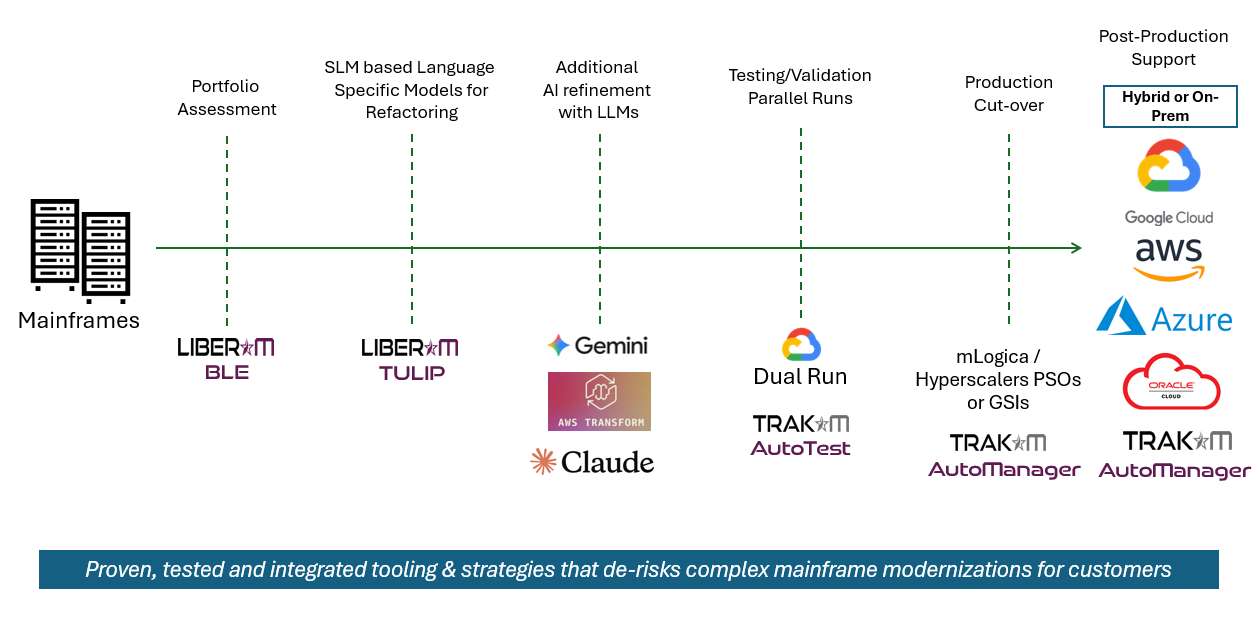
Portfolio Assessment (LIBER*M BLE)
The first step in the journey is to perform a comprehensive portfolio assessment using LIBER*BLE. This phase analyzes the entire application landscape to create a detailed inventory of assets, dependencies, data flows, and business logic. By extracting and documenting embedded business rules, this phase provides a clear and factual baseline for decision-making. It identifies redundancies, missing components, and complexity hotspots, enabling organizations to define the scope, sequencing, and strategy for modernization with confidence.
Refactoring with SLM-Based Models (LIBER*M TULIP)
In the transformation phase, LIBER*TULIP applies language-specific Small Language Models (SLMs) combined with deterministic transformation engines to refactor legacy code into modern target languages and platforms. These SLMs are trained on domain-specific patterns derived from real production systems, allowing for accurate and scalable code conversion. This phase ensures that the transformed code preserves functional intent while aligning with modern architectural standards.
AI Refinement with LLMs
Following deterministic transformation, additional refinement is performed using large language models (LLMs) such as Gemini, Claude, or AWS-native AI services. These models enhance code readability, optimize structure, and assist in identifying edge cases or improvement opportunities. Importantly, this layer operates within controlled boundaries, augmenting the transformation without compromising determinism, traceability, or auditability.
 Testing and Validation (Parallel Runs with TRAK*M AutoTest)
Testing and validation are conducted through parallel run environments, where the legacy system and the modernized system operate simultaneously. Using TRAK*M AutoTest, organizations validate functional equivalence, performance, and throughput against defined SLAs. This phase ensures that every business scenario behaves identically in the target environment, eliminating risk before production cutover. Issues are identified and resolved early, rather than after deployment.
Production Cutover (TRAK*M AutoManager)
Once validation is complete, the system transitions to production through a controlled cutover process managed by TRAK*M AutoManager, often in collaboration with mLogica, hyperscalers, and system integrators. This phase ensures a seamless switch from the legacy environment to the modern platform, with minimal disruption to business operations. Cutover strategies are carefully orchestrated to maintain continuity and meet operational requirements.
Post-Production Support (Hybrid or Cloud with TRAK*M)
After go-live, the modernized environment is supported through TRAK*M in hybrid, on-premises, or cloud environments such as AWS, Azure, Google Cloud, or Oracle Cloud. This phase focuses on operational stability, performance optimization, monitoring, and continuous improvement. It ensures that the system remains reliable, scalable, and aligned with evolving business needs while maintaining the benefits achieved through modernization.
Three Question Every CIO Should Ask
Gartner predicts that by 2030, 75 percent of vendors in the mainframe exit market will pivot their business models or cease to exist. Before committing to a modernization strategy this year, ask your vendor following three questions:
First: Is the AI deterministic or generative? If the vendor cannot answer this question clearly and specifically, the answer is generative, which means non-repeatable, non-auditable and non-certifiable. Ask for documentation of transformation consistency across runs on the same source input.
Second: What was the model trained on? Generic LLMs were trained on public data. Ask whether the vendor has domain-specific models trained on real mainframe production code at enterprise scale, in your industry, and across the languages in your estate. Ask to see the methodology, not just the claim.
Third: Is every transformation output traceable and auditable before deploying it to production? “We will test it after migration” is not an acceptable answer for systems your business depends on. Ask for a specific description of pre-cutover certification. Ask whether LIBER*M-equivalent validation tool exists in their toolchain. If they look puzzled, you have your answer.
Although AI has a genuine and valuable role to play in mainframe modernization, so does reimagination, when applied to the right functions, with the right governance. The problem Gartner has identified is that the belief that either can unilaterally substitute domain expertise, deterministic transformation, and pre-production certification.
The lesson from 35 years mainframe modernization experience is clear.
The winner in this era will not be the vendor with the most comprehensive model. It will be the vendor that can certify the output.
About the Author
Dr. Vazi Okhandiar, PMP, serves as the Vice President of the AI Center of Excellence at mLogica With over 30 years of experience, she has led innovation, architecture and design of highly complex enterprise systems across multiple industries. She is also a board member of Project Management Institute (PMI) Orange County chapter, where she contributes to advancing the field of project management with AI.
Prior to mLogica, she held key roles as a lead developer and architect at Computer Sciences Corporation and Electronic Data Systems (now part of DXC Technology). Throughout her career, she has received numerous awards for her contributions to enterprise-level software development. In academia, she served as Head of the Department of Computer Science at National University, where she helped shape future technology leaders.
She holds a Doctors in Business Administration of Walden University, an MBA from University of California Irvine, a Master’s degree in Computer Science from Illinois Institute of Technology, and a Bachelor of Science in Electrical Engineering. She has also been recognized for her entrepreneurial skills and nonprofit activities from various organizations, including United States Congress.
mLogica is headquartered in Las Vegas, Nevada, and operates globally across eleven cities in seven countries, delivering mainframe modernization programs in BFSI, healthcare, government, and other regulated industries worldwide.
Sources
- Gartner. “Too Big to Fail: Why Mainframe Exit Projects Are Likely to Fail in the Age of Generative AI.” April 2026. Dennis Smith, Alessandro Galimberti, Tobi Bet.
- Forrester Consulting / Rocket Software. Mainframe modernization survey, 309 global decision-makers. 2024.
- Industry post-mortem analysis: 29 mainframe-to-cloud migrations, 2020–2025. Software Modernization Services / Modernization Intel.
- Harvard Business School: Dell'Acqua, F., Ayoubi, C., Lifshitz, H., Sadun, R., Mollick, E., Mollick, L., Han, Y., Goldman, J., Nair, H., Taub, S., & Lakhani, K. R. (2025). The Cybernetic Teammate: A Field Experiment on Generative AI Reshaping Teamwork and Expertise. Harvard Business School Working Paper No. 25-043.
- ISG Provider Lens® Mainframes — Solutions 2026. Pedro L. Bicudo Maschio, Lead Analyst.
- Larry Ellison, Oracle. Q2 FY2026 Earnings Call and Oracle AI World 2025 Keynote.
- Wednesday.is. “Stuck in Transit: 3 Reasons Your Mainframe-to-Cloud Migration Failed.” November 2025. Industry rewrite failure rate citation.
- FutureCIO / Futurum Research. TSB Bank migration case and mainframe failure analysis. 2023.
- Modernization Intel. "Why Mainframe To Cloud Migration Challenges Cause 67% of Projects To Fail." softwaremodernizationservices.com, December 26, 2025.
- https://softwaremodernizationservices.com/insights/mainframe-to-cloud-migration-challenges/
