






























The Customer is an American Fortune 500 shipping, receiving and supply chain management company operating vast cargo networks and fleets throughout the US, Europe and Asia. With over $97 billion in total revenue in 2021, they have more than 500,000 employees globally and serve 220 countries and territories.

Liber*M Mainframe Modernization Suite

The LIBER*M Mainframe Migration Suite:
The cost-effective solution for businesses tied down by legacy mainframes
The AI-Powered Mainframe Modernization Journey with LIBER*M
From Legacy Complexity to Intelligent, Scalable Operations
Your Mainframes have decades of institutional knowledge, battle-tested business logic, and the operational backbone of your enterprise. Modernizing it demands more than a migration tool, it requires a governed, end-to-end program where automation, engineering expertise, and AI work together as one system.
mLogica delivers exactly that: an AI-Powered + Deterministic Modernization approach, with decades of training data to train our Language Specific Small language Model (SLMs). These models are purpose-built so that every transformation is repeatable, traceable, and audit-ready, and every AI contribution is validated before it ships.
The Modernization Engine
Mainframe estates are complex operational ecosystems, built over decades, embedding institutional knowledge that rarely exists in documentation. Modernization that treats this as a simple conversion fails. mLogica engineers it.
Four capabilities. One integrated engine.
- Automation Software: Deterministic pipelines. Repeatable transformations. Traceable outputs at enterprise scale.
- Proven Methodology: Evidence-led discovery, slice-based execution, and audit-ready certification at every release gate.
- Engineering Services: Deep cross-platform expertise across sequencing, governance, remediation, and production readiness.
- SLMs for translation and LLMs for AI enhancements: LIBER*M that accelerates discovery and transformation within guardrails that keep humans in command.
LIBER*M not only generates summaries, drafts, and code suggestions, it also plans and executes multi-step engineering tasks using approved tools and data sources. Both are accelerators, not substitutes, for deterministic transformation and auditability.
The LIBER*M & TRAK*M Journey
Stage 1 — Understand LIBER*M Powered Discovery & Knowledge Recovery
Modernization without evidence fails. DAHLIA and an Automated Knowledge Base build a governed inventory of every application, dependency, data structure, and workflow across your estate.
BLE surfaces embedded business logic so your teams can validate intent before a single line changes.
The result: a precise picture of what you have and a governed plan for what comes next.
Stage 2 — Transform LIBER*M Deterministic Conversion, AI-Accelerated
mLogica applies the right pathway, refactor, reengineer, or replatform, for each system. TULIP automates code conversion using language specific Small Language Models (SLMs) across COBOL, Assembler, Easytrieve, Telon, PL/I, and more languages to Java or C#.
IRIS handles data migration with full reconciliation controls. AI accelerates code understanding, documentation, and test scaffolding.
Deterministic pipelines control what ships.
Vendor-neutral by design, AWS, Azure, GCP, Oracle and leading ISVs, without single-stack lock-in.
Stage 3 — Operate & Evolve Intelligent Operations, Always Governed
Once live, the engine keeps working. CI/CD pipelines, AI-assisted development, and automated quality assurance become the operating model.
AI handles pattern-driven tasks, environment automation, test generation, runbook drafting, within approved guardrails.
TRAK*M extends managed services enterprise-wide. AutoTest augmented by AutoManager for post cutover run-operate-maintain phase, produces a release-gate evidence package, what changed, how it was validated, and why the system is certified safe to promote.
Humans stay in command. Every action is traceable. Every promotion is evidence-backed.
Mainframe Modernization Lifecycle Journey with LIBER*M & TRAK*M
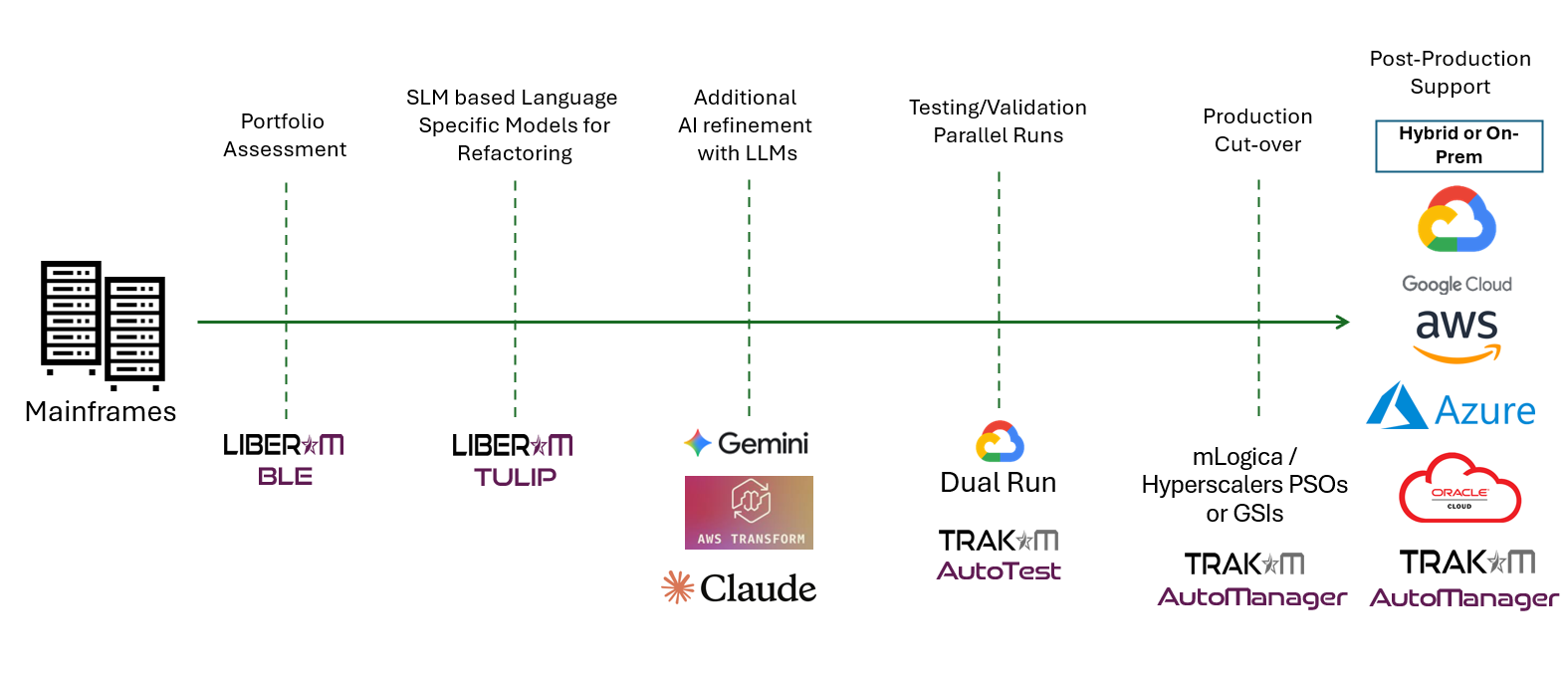
Proven, tested and integrated tooling & strategies that de-risks complex mainframe modernizations for customers
Proof at Every Gate
Enterprise modernization requires more than working code, it requires demonstrable proof.
mLogica’s AI driven TRAK*M AutoTest implements automated testing strategies, reconciliation harnesses, and parallel run validation at every stage to measure behavioral equivalence between legacy and modernized environments. Every release produces an evidence package: what changed, how it was validated, which controls were applied, and why the system is safe to cut over.
Leadership can review it. Auditors can rely on it. That's not a nice-to-have. In regulated industries, it's the difference between a successful program and a stalled one.
Why mLogica
AI-Powered, LIBER*M accelerate every phase of Mainframe Modernization Journey from Portfolio Assessment to Post-Production Support. Deterministic automation and human validation decide what ships. The two work together; neither replaces the other.
Vendor-Neutral by Design mLogica integrates leading hyperscaler and ISV technologies without tying your program to a single stack.
Broad language expertise, including COBOL, Assembler, Easytrieve, Telon, PL/I, Natural, and beyond, means consistent outcomes across diverse, large-scale portfolios.
Proven at Enterprise Scale Fortune 500 shipping companies. National government agencies. Global insurance firms.
The mLogica’s Centers of Excellence have delivered across the most demanding mainframe environments on the planet and built the evidence to prove it.
Proven GCOS8 (Bull) modernization enables seamless migration, reducing vendor lock-in while preserving business logic and transforming proprietary workloads into modern, supported cloud architectures
Legacy mainframes: Millions to maintain without key agility today’s business needs
Mainframe legacy applications are a critical asset to your business, but their technological limitations and sky-high support costs make them increasingly unsustainable in today’s business world. When it comes to modernizing z/OS and GCOS8 (BULL) mainframe applications the challenge is to preserve your existing business processes, gain flexibility and scalability—while slashing total cost of ownership.
Migrating Your Mainframe to the Cloud Can Save Millions
The average annual cost per installed MIPS is about $1,600. Hardware and software accounts for 65%
of this total, or approximately $1,040.
Consequently, the annual infrastructure cost for a 15,200 MIPS mainframe is approximately $16 million.
AWS Partner Network Blog; June 12, 2018
LIBER*M gives you options!
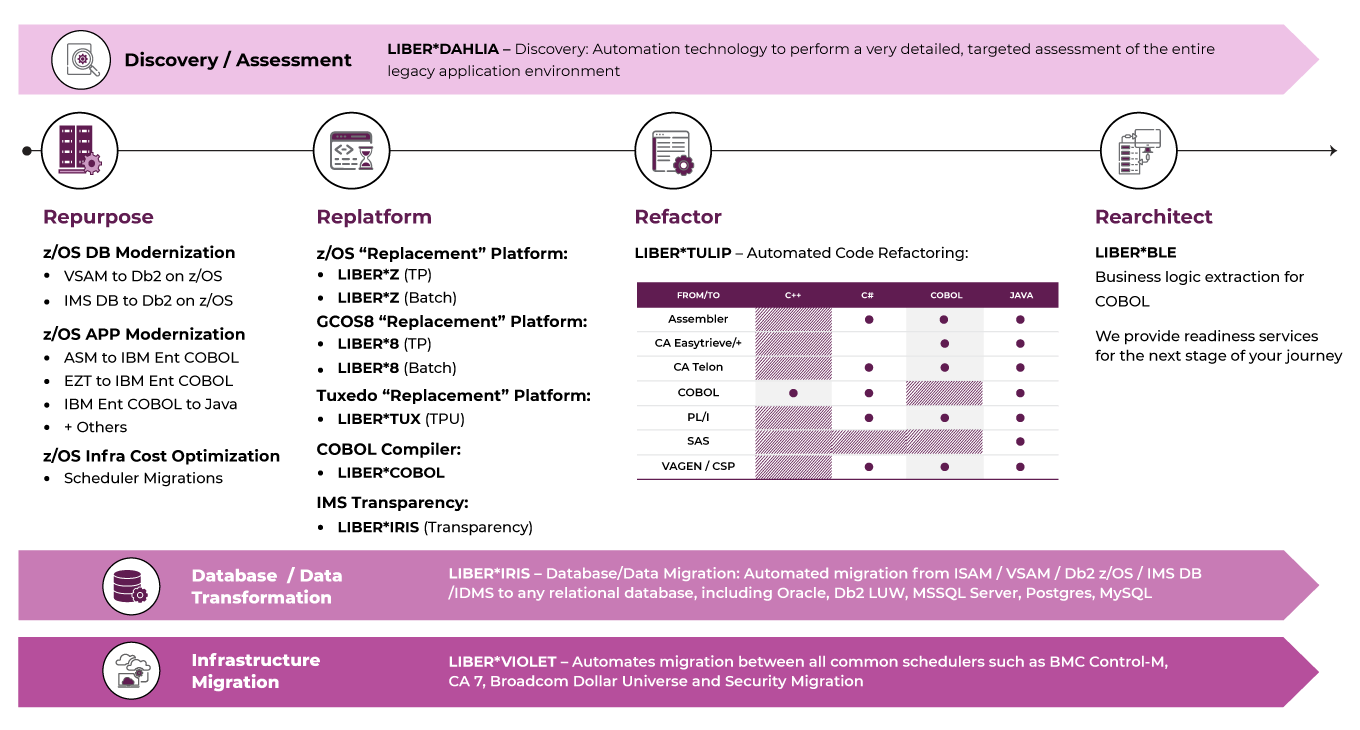
When modernizing your legacy z/OS or GCOS8 (BULL) databases and applications you have a variety of options based on your existing system, your current business needs and your goals for the future. These include:
- Repurposing
- Refactoring
- Replatforming
- Rearchitecting
At mLogica, our expert team can help you determine, through a comprehensive assessment of your existing system, which option or combination of options will help you achieve your goals for greater technical capabilities, increased agility and scalability and dramatically reduced IT costs.
As the experts in automated mainframe migration to the cloud, mLogica makes low-cost, low-risk mainframe modernization possible. Our proprietary automated technology, experienced team and rigorous quality assurance testing are the keys to seamlessly migrating large, complex, on-premise legacy z/OS or GCOS8 (BULL) mainframe business applications and databases to a modern cloud platform with maximum speed and accuracy.
Which mainframe modernization strategy is right for your business?
Repurposing
Not all organizations want to move off their mainframe technologies, due to factors including cost or regulatory obligations. For these businesses, it’s possible to repurpose selected applications and databases to level up their performance with the modern technology ecosystem.
On-premise mainframe datatypes and databases can be modernized and migrated to a relational database management system (RDBMS) while keeping them on-site. Examples include modernizing IBM IMS DB or VSAM to IBM Db2.
Similarly, aging programming technologies can be repurposed to integrate existing applications and databases with advanced programming toolsets. For example, re-factoring ASM to IBM Enterprise COBOL or IBM Enterprise COBOL to Java. Repurposing is also an excellent approach to consolidate technologies on both the data and programming language fronts.
This method makes existing mainframe technologies more powerful, maximizing operational efficiency with minimal cost impact—an effective approach for organizations that want to future-proof core applications, databases and programming languages built over time without migrating to an entirely new platform.
Refactoring
A more complex methodology, refactoring restructures and optimizes the existing code to improve performance, functionality and overall efficiency of mainframe programs. This approach implements significant modifications to the code base of applications and databases, with the goal of removing technical debt and improving non-functional attributes that restrict agility, cost efficiency and innovation.
Refactoring allows businesses to modernize legacy database environments such as ISAM, VSAM, Db2 and IMS DB to a relational RDBMS environment. We can also refactor legacy mainframe programming technologies such as Easytrieve, Assembler, Telon, PL/I and other 4GLs to COBOL, Java and C# and migrate COBOL to Java, C#, and C++.
In-Depth Experience Lets Us Create Solutions Customized for Your Needs
While many organizations prefer to refactor Assembler code directly to a more modern language such as Java or C#, there are situations in which COBOL is a logical target. These include:
- Optimizing on the mainframe by consolidating existing languages to COBOL
- Retaining the ability to leverage in-house COBOL expertise
- Replatforming mainframe COBOL to a distributed environment, which requires refactoring Assembler to COBOL
Refactoring Assembler to COBOL or Java with mLogica’s LIBER*M automated conversion software suite ensures compatibility with the target system, addresses system dependencies, aligns data representations and improves code maintainability. Inaccurate refactoring can result in migration failures, including runtime errors, incorrect results and difficulties maintaining the migrated system.
Natural and Adabas Modernization
Modernize high-value legacy systems
Natural 4GL and Adabas still power critical business functions, but aging skills, rising MIPS and licensing costs, complex data structures, and cloud integration barriers make them harder and more expensive to sustain.
Automate Natural 4GL refactoring
LIBER*DAHLIA analyzes your portfolio and surfaces dependencies early. LIBER*TULIP accelerates Natural 4GL refactoring to Java, C#, and C++ while preserving core business logic and reducing modernization risk.
Execute high-fidelity Adabas to cloud migration
LIBER*IRIS enables precise Adabas to cloud migration and transformation to relational and cloud-ready databases. BLE Intelligence helps extract embedded business rules that are often undocumented but essential to success.
De-risk Complex Natural and Adabas Modernization
mLogica combines proprietary automation with deep delivery expertise to complete complex mainframe modernization Natural initiatives faster, with lower risk, stronger accuracy, and better outcomes than manual or incomplete approaches.
Replatforming
Replatforming migrates a business’s mainframe applications and databases to a new runtime environment with minimal changes to the code, while simultaneously ensuring code structures, functions and features remain intact. This allows organizations to offload their mainframe technologies from legacy z/OS, GCOS8 (BULL) and more to an x86-based Linux environment and transform them using new and better toolsets.
Rearchitecting
Rearchitecting materially changes the code of mainframe programs. This approach migrates mainframe workloads to new application architecture so that enterprises can integrate advanced features into their applications and databases.
Rearchitecting starts with an automated in-depth analysis of the existing assets, including assessment and abstraction of embedded business rules using business logic extraction (BLE) technology. Once this process is completed, automated tools can be effectively used to create the bulk of the new application.
Rearchitecting end-of-life mainframe systems allows businesses to gain enhanced capabilities by leveraging an optimized mix of modern technologies. This is an effective approach when the objective is not just to perform a like-for-like replacement, but to implement functional changes without undergoing a full rewrite.
mLogica clears the way to mainframe migration to the cloud by effectively reconciling the twin demands of business: protecting the rich functionality of legacy applications while using standard and open-source technologies to slash total cost of ownership turning your systems into a platform for innovation.
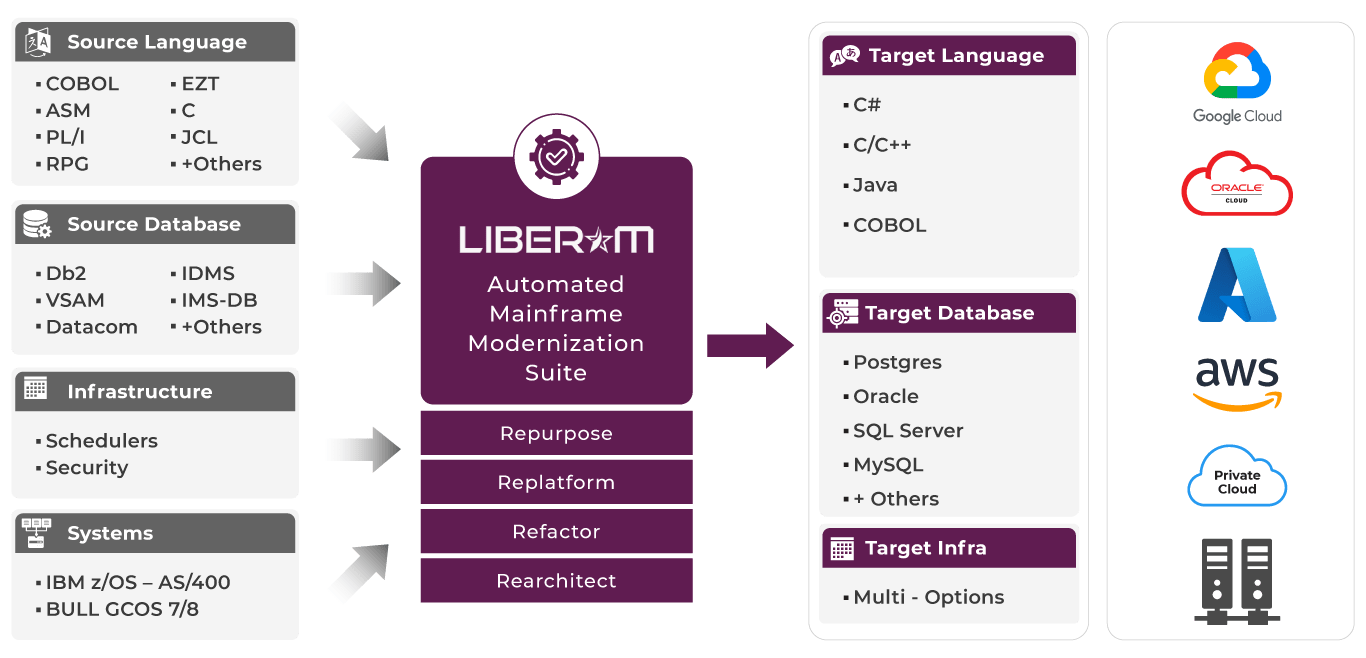
Designed for rapid, controlled, virtually seamless modernization of mainframe business applications, the LIBER*M Mainframe Modernization Suite combines the best of legacy application modernization approaches, allowing organizations to migrate off mainframes while still fully leveraging their existing assets.
With LIBER*M, mLogica offers the most powerful suite of legacy migration tools available, leveraging decades of expertise in cross-platform migration of the most business-critical enterprise software and mainframe environments. We also license our compiler and translator to our customers in a subscription model.
Unlocking Business Logic for Seamless Mainframe Modernization
Legacy modernization is a complex challenge, often hindered by the difficulty of extracting and understanding decades-old business logic embedded in mainframe applications. mLogica’s Business Logic Extractor (BLE) Intelligence simplifies this process by leveraging AI to analyze, document, and transform legacy code into actionable insights. By automatically identifying business rules, dependencies, and redundant code, BLE Intelligence accelerates the transition from outdated systems to modern, scalable architectures.
With features like automated business rule extraction, an intuitive visual editor, and AI-powered code analysis, BLE Intelligence ensures that critical business processes are preserved while enabling seamless integration with cloud and modern platforms. This not only reduces the risks associated with legacy system migration but also enhances agility and innovation. For enterprises looking to future-proof their operations, BLE Intelligence offers a powerful, efficient solution to unlock the full potential of their legacy systems.
Key Features of BLE Intelligence:
- Automated Business Rule Extraction – Identify and document legacy system logic with AI-driven precision.
- Comprehensive Code Analysis – Understand dependencies, execution paths, and database usage.
- User-Friendly Visual Editor – Validate and refine extracted rules with interactive tools.
- Accelerated Modernization – Generate structured documentation to streamline migration efforts.
Future-proof your legacy systems with BLE Intelligence and unlock new possibilities for innovation.
LIBER*M Customer Success Stories
Mainframe modernization, whether on-prem, to the cloud or via a hybrid solution, has saved mLogica clients millions in support and licensing costs while boosting critical adaptability, scalability, performance and security.
GLOBAL SHIPPING PROVIDER DATABASE MIGRATION FROM IBM IMS TO IBM Db2
To download the complete customer success story click the button below.

Government Agency - MODERNIZATION OF ALL STRATEGIC APPLICATIONS
The Customer is a national public sector agency that provides diverse forms of social security payments to more than ten million beneficiaries in their country. These include subsidies for housing, family and childcare support, educational allowances and more
To download the complete customer success story click the button below.

GOVERNMENT AGENCY - REFACTORING MULTIPLE TECHNOLOGIES TO JAVA AND MIGRATION OF IBM Db2 TO ORACLE
The Customer is a government agency that for more than fifty years has processed, provided and serviced billions in student loans and grants to recipients both domestically and internationally. The organization also disburses loans for various other social programs and performs amortization services.
To download the complete customer success story click the button below.

MAJOR INSURANCE FIRM - DATABASE MIGRATION FROM MAINFRAME TO X86 CLOUD PLATFORM WITH MS SQL SERVER
Founded in 1824, the Customer is a European insurance company that offers an array of coverage for businesses and individuals, including life, auto, accident and more, in addition to supplementary pensions. They also have a distribution partner network of over 5,000, including brokers, agents and banks. With more than 4,000 employees, over 2.7 million retail customers and 245,000 corporate and self-employed clients, the company’s operating profit in 2020 was €636.1 million.
To download the complete customer success story click the button below.

liber*m fact sheet
Your legacy mainframe applications are vital to your daily business, but they come with sky-high support costs, a dwindling labor pool trained to support them, and critical technological shortcommings that limit your ability to grow, adapt and maintain data security.
To download the complete customer success story click the button below.

MAINFRAME MODERNIZATION FOR GLOBAL OIL AND GAS COMPANY
The Customer is a major oil and gas corporation offering a variety of petroleum products and services to clients worldwide.
To download the complete customer success story click the button below.
Download Your Success Story
Complete the form below to receive your downloadable mLogica success story
