




































Building a National Crypto Tax Monitoring Capability
Suyash Singh – Product Manager - Analytics Solutions
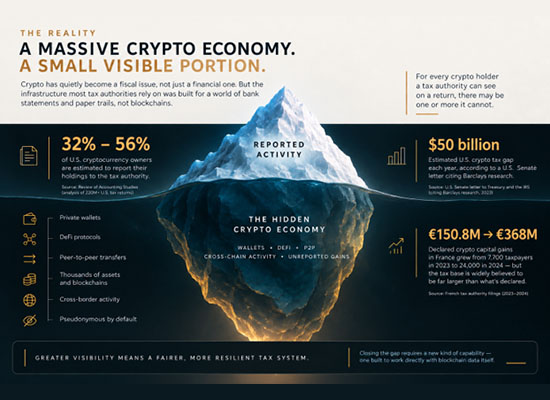
Crypto is now a fiscal issue, not only a financial one. Intermediary reporting under the OECD Crypto-Asset Reporting Framework (CARF) and the EU’s DAC8 is coming online for the 2026 period, with first automatic exchanges expected in 2027. That will improve visibility. It will not, by design, give tax authorities a complete view of activity that never touches a reporting service provider. The infrastructure most tax authorities rely on today, however, was built for a world of bank statements and paper trails, not blockchains.
The crypto tax gap in the U.S. is estimated to be around $50 billion a year. The IRS has said its figures cannot fully account for all types of noncompliance, including other digital assets. Independent research on IRS administrative data makes the visibility problem concrete. A 2026 study in the Review of Accounting Studies (Hoopes, Menzer, and Wilde), using IRS data on more than 220 million returns, found 17.4 million people with cryptocurrency on a U.S. return between 2013 and 2021. External estimates of U.S. ownership run to 31-54 million. Most estimated owners never appear in IRS reporting data. Only 7.6 million of those 17.4 million reported sales.
This is not a problem specific to the US. In France, 7,700 taxpayers declared €150.8 million in net crypto capital gains for 2023 income. A year later, 24,000 declared €368 million (DGFiP). Filings rose sharply. According to authorities, the declared base is still too small.
Why Crypto Breaks the Traditional Monitoring Model
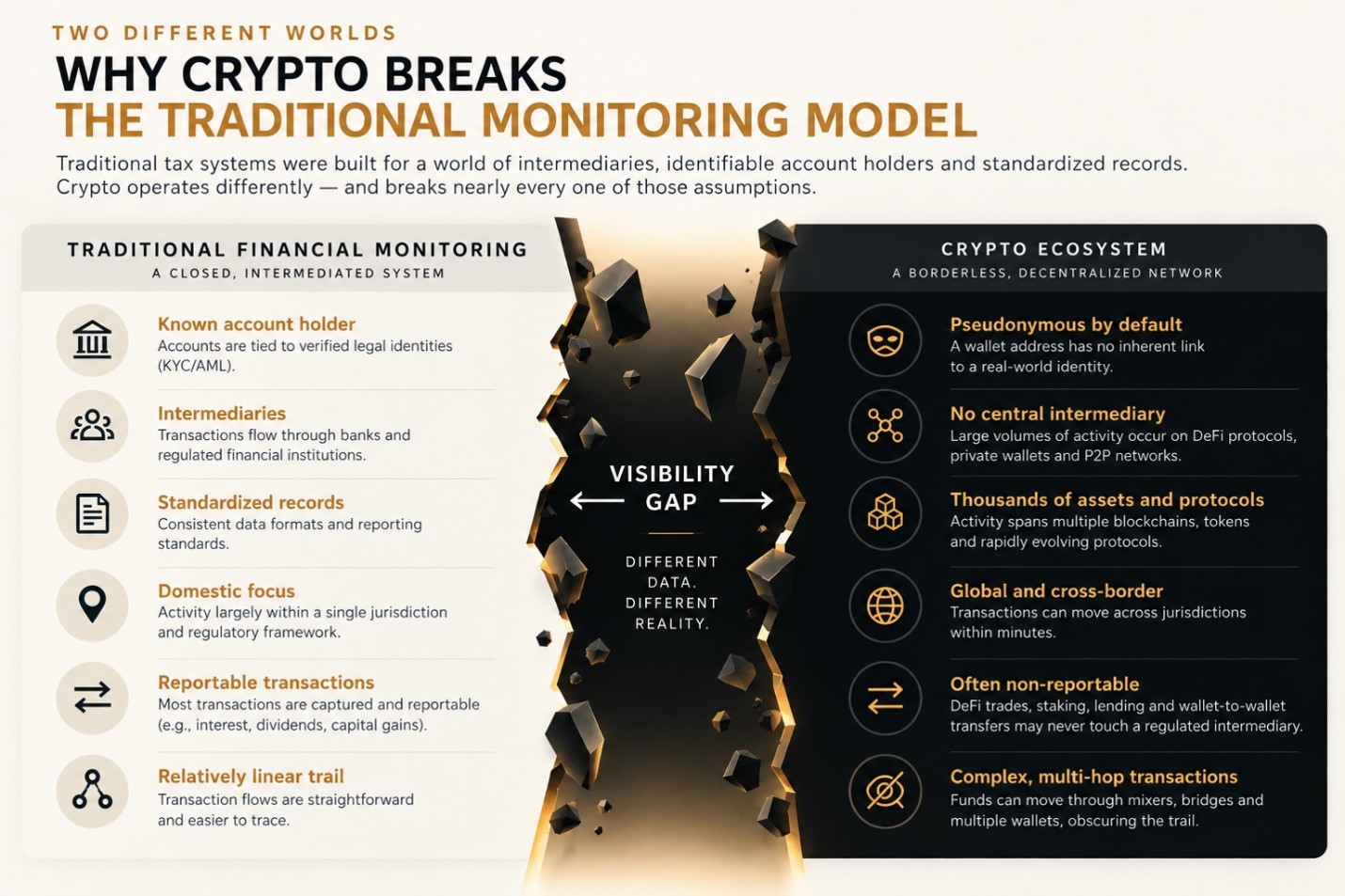
Most national tax systems were designed around a small number of predictable, intermediated data sources, including banks, payroll systems, and registered businesses. Crypto breaks nearly every one of those assumptions.
Transactions are pseudonymous by default. An on-chain wallet address carries no inherent link to a legal identity. Activity moves across thousands of distinct assets, protocols, and ledger formats, and in some cases crossing blockchains or jurisdictions along a single transaction path. A large and growing share of that activity, including decentralized exchange of trades, peer-to-peer transfers, staking and lending income, and direct wallet-to-wallet payments, can take place without passing through a centralized, reportable intermediary.
That last point matters enormously for policy design. The OECD's Crypto-Asset Reporting Framework, or CARF, is the emerging global standard, with jurisdictions beginning reporting for the 2026 period and the first automatic exchanges of information expected in 2027. CARF is built primarily around intermediary reporting, with Reporting Crypto-Asset Service Providers collecting and reporting information about relevant transactions and users. This is necessary, but it cannot provide complete visibility into activity that takes place entirely outside reporting service providers. Certain transfers involving external wallets can still fall within CARF reporting requirements, and some decentralized platforms may fall within scope where an individual or entity exercises sufficient control or influence. However, activity conducted entirely through private wallets, peer-to-peer transactions, or decentralized protocols without a reportable service provider can remain outside direct intermediary reporting.
For a tax authority, this means the reporting frameworks now coming online will provide real, valuable visibility, but not complete visibility. Closing the rest of the gap requires a fundamentally different kind of capability; one built to work directly with blockchain data itself, not just with information provided through reporting intermediaries.
The Components of a National Crypto Monitoring Capability
A credible national-scale capability rests on four layers. This is the operating model required if on-chain data is going to sit beside CARF/DAC8 reports in an auditor case file rather than in a separate analytics silo.
Ingestion. The foundation is the ability to pull in on-chain and off-chain transaction data across all relevant cryptocurrencies and protocols and fuse it with the off-chain data that gives it meaning. This includes VASP and exchange reporting under frameworks like CARF and DAC8, banking data for fiat on and off ramps, company registries and beneficial ownership records, customs data for import and export valuations, court judgments, and existing VAT and income tax filings. Crypto monitoring only becomes useful when it is correlated against everything else a tax authority already knows about a taxpayer, rather than being treated as a separate silo.
Analytics. Raw transaction data is not intelligence. The core analytical work is deanonymization: take a wallet, match it to a name when an exchange KYC file, CARF report, or other lawful record makes that match, then trace and cluster from there. Pair that with risk scoring flags, anomalous patterns, unreported activity, and evasion across a larger wallet pool than a team can review manually.
Governance. None of this is useful to a tax authority if it cannot survive legal scrutiny. That means built-in data lineage, audit trails, and documentation standards. The goal is not an internal risk score. It is a case file a prosecutor can actually use.
Integration. Crypto tax intelligence should not be a separate system added to existing infrastructure. It needs to plug into the tax authority's existing case management, unified taxpayer register, and reporting infrastructure alongside VAT, personal income, and corporate tax modules. The same taxpayer entity often appears across all of them, and evasion patterns rarely stay confined to a single tax type.
What This Looks Like in Practice
The most useful version of this is not a dashboard full of statistics. It is a working tool for people conducting investigations. In effect, it functions as a discovery and triage system, with every tracked wallet or entity scored and ranked by risk, a queue of leads sorted by priority rather than by whoever happened to file a complaint, and a case record that brings transaction history, risk signals, and de-anonymization evidence together in one place.
Just as important is making that intelligence usable by nontechnical stakeholders. A natural language query layer, allowing users to ask questions such as "show me the top high-risk cases by district" or "show me supplier dependency risk for VAT credits," turns a complex analytics platform into something a case officer, auditor, or policy team can use without writing a query.
Where Archon Insights Fits
Archon Insights, mLogica’s intelligence layer for digital assets, is built to deliver that operating model rather than a standalone crypto dashboard.
At its core, Archon Insights unifies fragmented, unstructured on-chain data with off-chain context, including regulatory data, government databases, and real-time financial data, turning it into something actionable. It is built around three data layers: the raw on-chain record (block data), that record enriched with off-chain context (augmented data), and the analyst-ready output an investigator or system needs (derived data).
For a national tax authority, that translates directly into the four components above. Archon's unified intelligence engine handles ingestion, aggregating on-chain and off-chain sources into a single layer that is ready for API access. Its dynamic risk scoring, entity tagging, and alerts on illicit flows and mixer activity are the analytics layer: they match what intermediaries already report to what the chain shows, and they put unreported wallets tied to known taxpayers at the front of the audit queue. Its forensics and investigation tools handle the multi-hop tracing needed for de-anonymization.
Automated audit and compliance functionality, with built-in data lineage, addresses the governance requirement: a documented trail a case officer can hand to counsel. Because Archon Insights is delivered through flexible APIs and embeddable dashboards, it integrates into a tax authority's existing case management and unified taxpayer systems rather than sitting apart from them. This turns what would otherwise take years to build internally into a foundation that is ready to deploy against a specific national mandate.
Intermediary reporting will not close the gap by itself. What is missing is an intelligence layer that treats the blockchain as a data source and puts that data in the same file as everyone else the authority already knows. That is what Archon Insights is built to be.
Request a demo of Archon Insights to see how tax authorities can close the visibility gaps CARF and DAC8 leave behind, with on-chain intelligence that sits right beside the reports they already receive.
Resources
- Internal Revenue Service, Who Reports Cryptocurrency to the IRS? (SOI Working Paper)
https://www.irs.gov/pub/irssoi/25rpWhoReportsCrypto.pdf - U.S. Government Accountability Office, Tax Gap: IRS Should Take Steps to… (GAO24106449)
https://www.gao.gov/assets/gao24106449.pdf - Vernita Tax Law, Crypto and Tax Crime Watch: Why Digital Assets Remain a Top IRS Enforcement Priority (citing IRS Criminal Investigation FY2025 Annual Report figures)
https://vernitaxlaw.com/irscryptotaxenforcementpriority/ - The Currency Analytics, France Faces Crypto Tax Gap (citing official DGFiP filing statistics for 20232024)
https://thecurrencyanalytics.com/altcoins/francefacescryptotaxgap94billiontaxableonly368millionreported291005 - OECD, Crypto-Asset Reporting Framework: 2025 Monitoring and Implementation Update
https://www.oecd.org/content/dam/oecd/en/networks/globalforumtaxtransparency/cryptoassetreportingframeworkmonitoringimplementationupdate2025.pdf - OECD, Jurisdictions Committed to Implement the Crypto-Asset Reporting Framework (CARF), last updated 23 June 2026
https://www.oecd.org/content/dam/oecd/en/networks/globalforumtaxtransparency/commitmentscarf.pdf - U.S. Senate letter to Treasury and the IRS, citing Barclays research estimating the U.S. crypto tax gap at roughly $50 billion a year
https://www.warren.senate.gov/oversight/letters/warrencaseyblumenthalsanderscallontreasuryirstoreinincryptotaxevadersclose50billioncryptotaxgap
Suyash Singh – Product Manager - Analytics Solutions
- Share on