




































How AI Helps Tax Authorities Discover Taxable Events in Crypto Networks

Suyash Singh – Product Manager - Analytics Solutions
Transforming Blockchain Activity into Actionable Tax Intelligence Through AI and Advanced Analytics
The Growing Challenge of the Crypto Tax Gap
Digital assets have evolved from a niche investment class into a significant component of the global financial system. As cryptocurrency adoption accelerates across retail, institutional, and decentralized finance (DeFi) markets, tax authorities face growing challenges in identifying and assessing taxable activity at scale.
Governments continue to confront substantial tax gaps, and as crypto adoption grows, digital assets represent an increasingly important source of potential revenue leakage.
Many assume that blockchain transparency solves this problem. After all, every transaction is recorded on a public ledger. However, blockchain transparency does not automatically create tax compliance. Tax authorities may be able to see transactions, but determining who conducted them, what economic activity occurred, and whether they resulted in a taxable event remains far more challenging.
The challenge is no longer gaining access to blockchain data, it is transforming vast volumes of blockchain activity into actionable, explainable, and audit-ready tax intelligence.
Why Blockchain Transparency Is Not Enough
While blockchain networks provide unprecedented transaction visibility, they do not automatically provide taxpayer visibility. Wallet addresses are pseudonymous, and a single taxpayer may control multiple wallets across exchanges, blockchains, and DeFi protocols. Assets frequently move across platforms before ultimately being converted into fiat currency or transferred elsewhere.
These transaction journeys often span multiple networks and involve numerous intermediary addresses. A taxable event may be hidden several steps away from the original transaction, making it difficult to reconstruct a complete picture using manual methods alone.
Compounding the challenge, not every blockchain transaction is taxable. A transfer between wallets controlled by the same taxpayer may not trigger a tax liability, while a token swap, staking reward, NFT sale, or liquidity pool withdrawal may. Blockchain data reveals activity, but it does not necessarily reveal tax meaning.
This distinction is why traditional investigative approaches struggle to scale in modern crypto ecosystems.
How AI Helps Tax Authorities Discover Taxable Events
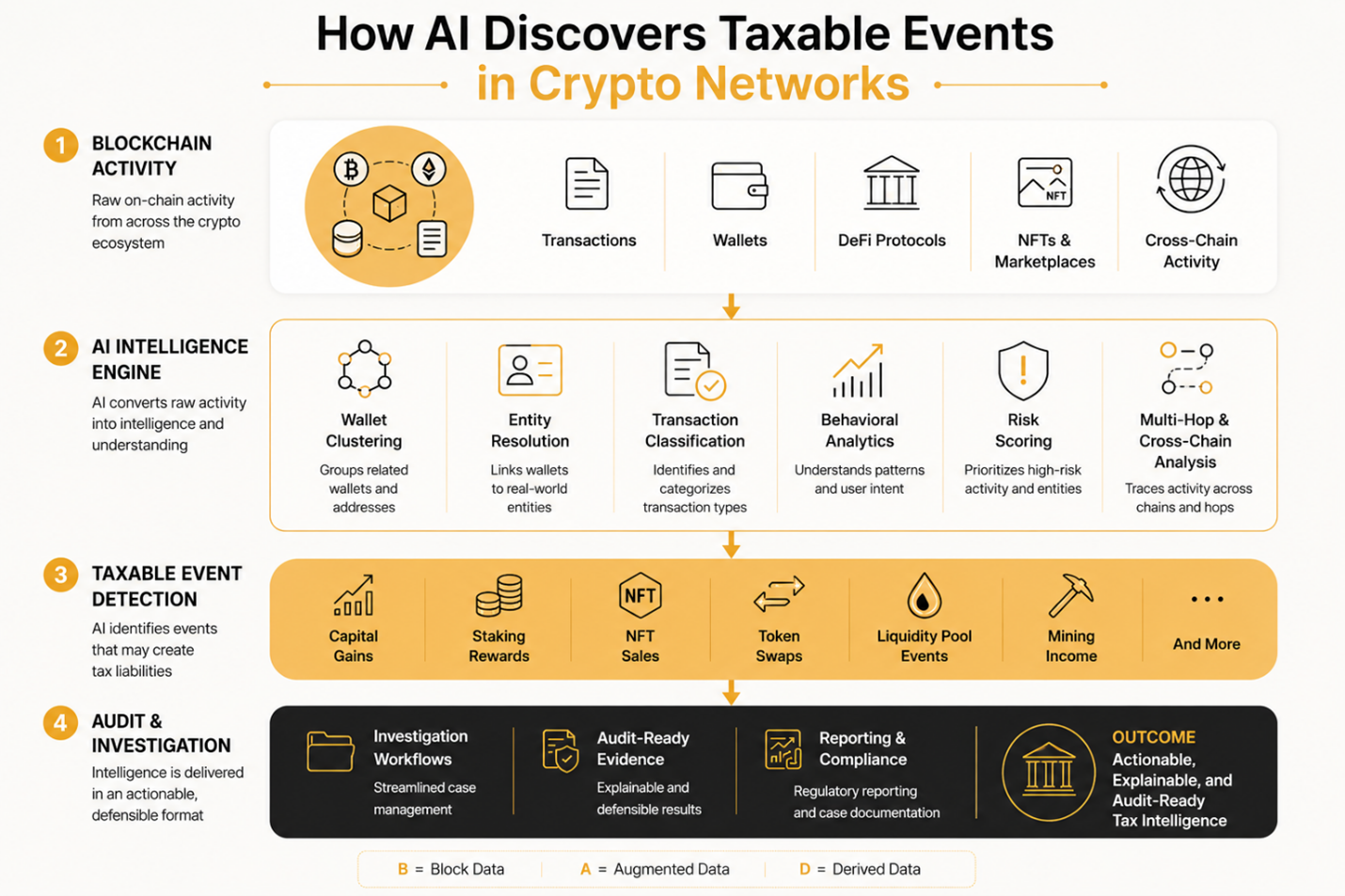
Artificial intelligence helps bridge the gap between transaction visibility and tax intelligence. As crypto ecosystems expand across blockchains, exchanges, DeFi protocols, NFT marketplaces, and cross-chain bridges, tax authorities face a scale problem. Millions of wallets can generate billions of transactions, making manual review and traditional rules-based approaches increasingly impractical. AI enables authorities to continuously classify, prioritize, and interpret activity at a scale that would be impossible through human investigation alone.
One of the most valuable capabilities is wallet clustering, which identifies relationships between wallet addresses that likely belong to the same individual or entity. Instead of viewing wallets in isolation, investigators can analyze activity across an entire taxpayer network.
AI also supports entity resolution, which combines blockchain activity with external information sources to help connect digital asset activity to real-world entities. AI helps uncover relationships across wallets, exchanges, and protocols that may not be immediately visible to investigators, particularly when activity spans multiple blockchains. For tax authorities, this is a critical step because enforcement actions are ultimately directed at taxpayers, not wallet addresses.
Perhaps the most important capability for tax authorities is transaction classification. Crypto tax enforcement is fundamentally a classification problem. Tax authorities can often see transactions occurring on a blockchain, but determining their tax treatment is significantly more difficult.
Machine learning analyzes transaction patterns and behavior to determine the most likely economic meaning of an activity, helping distinguish between self-transfers, token swaps, staking rewards, NFT sales, and other events with different tax consequences.
By automatically classifying activity, AI helps convert millions of blockchain transactions into tax-relevant events that can be assessed under existing tax rules.
AI also enables behavioral analytics and risk scoring. Crypto tax enforcement is not only a classification problem but also a prioritization problem. Tax authorities cannot investigate every wallet, transaction, or taxpayer equally.
AI helps identify elevated compliance risks and prioritize the wallets, entities, and transaction chains most likely to warrant investigation, allowing authorities to focus limited resources more effectively.
In increasingly complex ecosystems, multi-hop tracing and cross-chain analytics have become equally important. Assets frequently move across wallets, protocols, bridges, and blockchains before reaching an exchange or generating a taxable outcome.
AI helps reconstruct these transaction journeys by identifying relationships and behavioral patterns that would be difficult to detect manually across millions of transactions. This allows investigators to maintain visibility even when activity spans multiple chains and numerous intermediary addresses.
Consider a taxpayer who converts Bitcoin into Ether, swaps Ether into a stablecoin, deposits it into a DeFi liquidity pool, and later cashes out through an exchange.
A traditional investigation may view these as separate transactions. AI can analyze the entire journey, identify related activities, classify potential taxable events, and focus investigators on the most meaningful compliance risks.
Together, these capabilities help tax authorities move from reviewing transactions to understanding taxpayer behavior.
Why AI Needs Context to Deliver Accurate Tax Intelligence
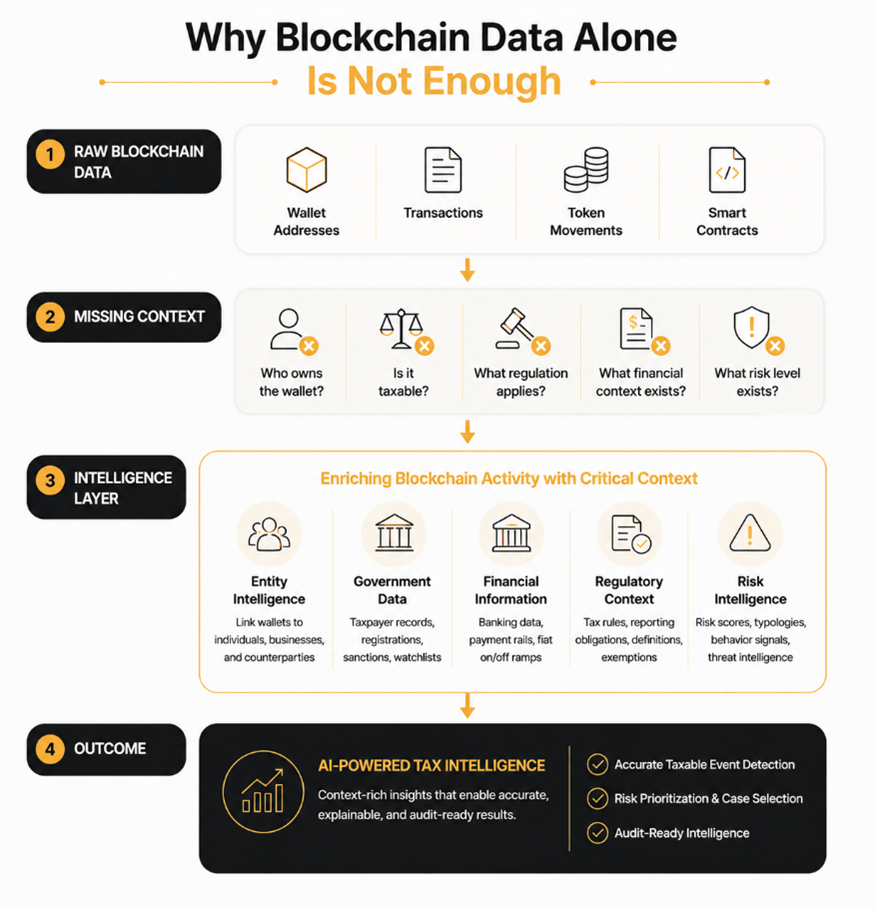
Although AI can significantly improve taxable event detection, it is only as effective as the information available to it. AI can identify patterns and relationships, but it cannot reliably determine tax meaning without sufficient context.
A blockchain transaction may indicate that an asset moved, but it rarely explains who controlled the wallet, why the transaction occurred, or how it should be interpreted under tax law.
Raw blockchain data provides transaction records but often lacks critical context. A transaction may show that assets moved from one wallet to another, but it may not reveal ownership relationships, regulatory obligations, associated entities, or the broader financial context surrounding the activity.
The same transaction pattern may have different tax implications depending on jurisdiction, taxpayer type, and reporting obligations.
This is why modern crypto tax intelligence increasingly relies on enriched data environments that combine blockchain activity with:
- Entity intelligence
- Government and taxpayer records
- Financial information
- Regulatory data
- Risk indicators
- Investigative context
When blockchain activity is enriched with these additional layers of intelligence, AI can make more accurate classifications, generate more reliable risk assessments, and produce more defensible investigative outcomes.
Governments Are Already Modernizing Crypto Tax Enforcement
Leading tax authorities are already investing in data-driven approaches to digital asset compliance.
The IRS has expanded its focus on digital assets through enhanced reporting requirements, increased compliance initiatives, and broader integration of analytics into enforcement activities. Digital assets are no longer treated as a niche issue but as a core component of modern tax administration.
Similarly, the Australian Taxation Office (ATO) has developed sophisticated data-matching capabilities to identify discrepancies between taxpayer reporting and financial activity. These initiatives demonstrate how data integration and analytics can improve compliance outcomes at scale.
At the international level, the OECD's Crypto-Asset Reporting Framework (CARF) and the European Union's DAC8 framework are creating new standards for crypto reporting and information sharing. These initiatives are expected to significantly improve data availability for tax authorities worldwide.
Collectively, these developments indicate that crypto tax enforcement is evolving from periodic audit exercises into continuous, intelligence-led compliance programs supported by advanced analytics, automation, and enhanced visibility across digital asset ecosystems.
From Blockchain Data to Tax Intelligence
As reporting volumes increase and crypto ecosystems become more complex, tax authorities need more than transaction monitoring. They need intelligence infrastructure capable of transforming data into actionable outcomes.
This is where digital asset intelligence platforms become increasingly important. Archon Insights serves as the Intelligence Layer for Digital Assets, helping tax authorities connect blockchain activity with the contextual information required to generate meaningful compliance outcomes.
By unifying on-chain activity with off-chain information, entity intelligence, regulatory context, financial data, and risk indicators, Archon helps transform fragmented blockchain activity into explainable and actionable tax intelligence. This enriched intelligence environment supports AI-powered taxable event detection, risk prioritization, and audit-ready analysis.
The objective is not simply to collect more data. It is to help tax authorities identify the transactions, entities, and risks that matter most.
The Future of AI-Powered Crypto Tax Compliance
Digital asset ecosystems will continue to evolve. New transaction models, emerging protocols, tokenized assets, and cross-chain interactions will introduce additional complexity for tax authorities.
The question is no longer whether taxable crypto activity can be identified. The question is whether tax authorities possess the intelligence capabilities required to identify it efficiently, consistently, and at scale.
AI is rapidly becoming a foundational component of modern tax administration. When combined with enriched intelligence, explainable analytics, and scalable compliance infrastructure, it enables tax authorities to move from reactive investigations toward intelligence-led compliance operations.
Tax authorities that invest early in AI-powered tax intelligence capabilities will be better positioned to reduce revenue leakage, improve audit effectiveness, and maintain visibility across increasingly complex digital asset ecosystems.
Contact
Ready to reduce your crypto tax gap and uncover previously unidentified taxable activity?
Archon Insights helps tax authorities transform complex blockchain activity into actionable taxpayer intelligence through AI-powered analytics and audit-ready investigations. Contact us to learn how your agency can strengthen compliance and improve revenue recovery.
References & Further Reading
- Organisation for Economic Co-operation and Development (OECD). Crypto-Asset Reporting Framework (CARF) and Amendments to the Common Reporting Standard. OECD.
- Organisation for Economic Co-operation and Development (OECD). Tax Administration Series and OECD research on the adoption of Artificial Intelligence within tax administrations.
- Internal Revenue Service (IRS). Tax Gap Projections and Digital Asset Compliance Initiatives. U.S. Department of the Treasury.
- Internal Revenue Service (IRS). Digital Assets Guidance and Reporting Requirements. U.S. Department of the Treasury.
- Australian Taxation Office (ATO). Data Matching and Cryptocurrency Compliance Programs. Australian Government.
- Organisation for Economic Co-operation and Development (OECD). Taxing Virtual Currencies: An Overview of Tax Treatments and Emerging Tax Policy Issues.
- Financial Action Task Force (FATF). Virtual Assets and Virtual Asset Service Providers (VASPs): Guidance for a Risk-Based Approach.
- Council of the European Union. Directive on Administrative Cooperation (DAC8) for Crypto-Assets and E-Money.
- International Monetary Fund (IMF). Research and policy publications related to digital assets, tax administration modernization, and data-driven compliance.
- Norwegian Tax Administration (Skatteetaten). Research and compliance initiatives relating to cryptocurrency ownership disclosure and tax reporting.
- OECD Forum on Tax Administration (FTA). Publications on digital transformation, advanced analytics, and AI-enabled tax administration.
Suyash Singh – Product Manager - Analytics Solutions
- Share on