





























Mainframe Modernization Cutover-Safe Data Conversion
The mLogica Migration Team
Your mainframe estate can survive technical change. What it cannot survive is business disruption at cutover, which is the moment when data, not code, decides whether the program succeeds, or not.
In 2026, modernization leaders face a convergence of forces: regulatory scrutiny is rising, customer tolerance for downtime is shrinking, and experienced mainframe talent is harder to hire and retain. Kyndryl’s 2025 State of Mainframe Modernization report found that 70% of organizations struggle to find the skilled talent needed to modernize effectively. In that environment, “we’ll handle the data later” is not a plan; it is deferred risk.
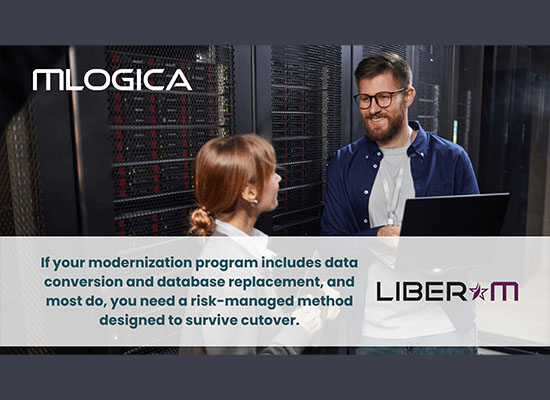
The core thesis is this: refactoring is critical, but it is not the only job. If your modernization program includes data conversion and database replacement, and most do, you need a risk-managed method designed to survive cutover. That method must deliver repeatable conversion pipelines, controlled schema evolution (meaning how data structures are modified safely as the target system matures), and continuous proof that you have preserved integrity, performance, and security posture.
 mLogica strengthens that proof loop with LIBER*M and parallel runs as part of an AI-Native + Deterministic Modernization operating model. LIBER*M applies deterministic conversion and validation patterns to generate consistent, repeatable outputs across runs, while Parallel Runs execute legacy and modernized data flows side-by-side to reconcile results in near-real time.
Together, they accelerate deterministic validation (catching semantic and reconciliation gaps early), improve audit readiness (producing traceable evidence of what changed, why, and how it was verified), and enable repeatable outcomes at portfolio scale, so cutover becomes a governed decision backed by measurable parity rather than a leap of faith.
Why data conversion becomes the cutover multiplier
Executives often think of data migration as copying records from one place to another. In mainframe environments, whether IBM Z, Unisys, or similar platforms, data conversion is far broader than that. Your organization typically runs on a mix of databases, record-based files, batch feeds, and downstream consumers such as reporting, billing, and reconciliation.
A database is not only storage. It encodes behaviors: how records are keyed, how concurrent updates are handled, how recovery works, and how performance is achieved under load.
Change those behaviors unintentionally and you can migrate “successfully” while breaking operations quietly.
Scenario: A large insurer modernizes its claims platform. The new UI and services work well, but the migration to a new database unintentionally disrupts long-standing batch-processing assumptions. Because data ordering and throughput behave differently on the new platform, the nightly batch window grows significantly. Nothing fails outright, no crashes, no errors, but operations can no longer finish overnight processing on time. As a result, the team cannot meet operational readiness criteria, and the planned cutover date must be delayed.
What database replacement really changes
Database replacement is often justified as a platform-level decision: moving to a managed database, a converged database, or an AI-data platform that supports analytics and AI alongside operational workloads. Those targets can be strategically sound, especially when you want to reduce platform sprawl and enable governed access across hybrid environments.
But replacement also changes runtime behavior. “Runtime parity” means your modern environment matches operational expectations: batch schedules complete within their window, transaction processing stays responsive, restart and recovery behave predictably, and monitoring catches issues early.
The best programs are explicit about intent: operational continuity (preserve critical behaviors), convergence (standardize and reduce brittle integrations), and modern capability (observability, security controls, and AI-ready access without uncontrolled copies).
Replacement is not automatically a big-bang event; it can be staged through incremental domains, synchronized data replication, and parallel runs, so long as you continuously prove parity in outputs, performance, and operational behavior at each step.
Five practices that separate ready from almost-ready
A cutover-safe approach looks less like a one-time migration and more like an evidence-driven operating model: repeatable runs, traceable evidence, and predictable outcomes. At mLogica, we see the same few practices separating “almost ready” from “ready to cut over”:
- Establish the data truth. Inventory authoritative sources, derived data, feeds, and consumers to expose hidden dependencies and implicit conventions.
- Engineer conversion pipelines, don’t script them. Treat extract-transform-load flows as governed assets with versioning and approvals, so reruns are reliable when scope evolves.
- Stage schema evolution. Modernize structures incrementally, keep mappings explicit, and retire legacy forms only after parity is demonstrated.
- Prove integrity, performance, and security continuously. Validate balances and exceptions, enforce security controls, and establish performance baselines for workloads, especially for batch and transaction processing.
- Design cutover as an operational event. Use controlled replication and bounded cutover windows where feasible, with rollback paths that are tested and ready to execute.
Scenario: A retail bank replaces a legacy data store and enables an AI-enabled data platform for fraud analytics. Two weeks after cutover, a regulator asks for evidence showing how balances were reconciled across products, including exceptions. Teams that built reconciliation logic, audit trails, and exception reporting into their design can respond quickly. Teams that relied on “happy-path testing” cannot produce the required evidence and must escalate.
How GenAI accelerates data work without becoming the risk
GenAI can meaningfully accelerate data conversion when it is used for the right tasks and kept inside clear guardrails. It can accelerate mapping documentation, generate first-pass transformation rules, and create validation scripts or reconciliation queries that would otherwise consume scarce specialist time.
GenAI can meaningfully accelerate data conversion when it is used for the right tasks and kept inside clear guardrails. It can accelerate mapping documentation, generate first-pass transformation rules, and create validation scripts or reconciliation queries that would otherwise consume scarce specialist time.
Agentic AI is GenAI that can plan and execute multi-step tasks under supervision, and can further compress discovery by navigating large portfolios, identifying patterns in record formats, and proposing candidate conversions. For teams with limited time or bandwidth, this is a practical advantage.
The line you cannot cross is letting AI become the arbiter of correctness. Your organization still needs deterministic pipelines, human accountability at approval gates, and regression validation that proves output equivalence over time.
AI accelerates delivery; evidence authorizes release.
Make cutover a confidence event
Mainframe modernization will remain a board-level topic because it is tied to resilience, regulatory exposure, and competitive agility. The organizations that win in 2026 and beyond will modernize in a way that is faster and more defensible, especially in the data layer.
The memorable takeaway is this: a successful cutover is earned long before cutover day. You earn it through repeatable conversion pipelines, staged schema evolution, and continuous proof that integrity, performance, and security posture remain intact at every step.
If you want a concrete starting point, request a 30-minute modernization readiness assessment with mLogica focused specifically on data conversion and database replacement. The goal is to identify where your data risks reside, what must be proven before cutover, and how to build a method that lets you modernize with confidence.

The mLogica Migration Team
- Share on