




































Monitoring Stablecoin Transactions for Tax Compliance and Risk

Suyash Singh – Product Manager - Analytics Solutions
Why Governments Need Continuous Oversight of the Fastest-Growing Corner of Digital Assets
In February 2026, stablecoins settled more value in a single month than the entire US ACH network processes over the same period. For a tax authority, that is not merely a crypto-market curiosity. It is a signal that a significant share of economic activity has moved onto payment rails that many agencies still monitor as though they were a niche asset class.
Why Stablecoins Dominate Transaction Volume
Stablecoin transaction volume has grown at a pace few payment systems have ever matched. Adjusted volume reached a record $1.79 trillion in June 2026 alone, pushing first-half 2026 volume to $8.82 trillion, already well ahead of the $5.8 trillion recorded for all of 2024. Full-year 2025 settlement volume reached $33 trillion, surpassing the annual throughput of major card networks.
The reason is structural rather than speculative. Bitcoin and Ether are still primarily held as stores of value, whereas stablecoins are designed to be spent. Their price stability makes them the preferred medium for digital payments, settlement, DeFi collateral, payroll, and increasingly cross-border remittances, which still average ~6.36% in fees globally against the G20 target of 3%. Stablecoin transfers run roughly 40% cheaper, helping explain why adoption continues to accelerate: more than a quarter of a billion on-chain addresses now hold a stablecoin balance.
One caveat is worth stating plainly. Raw on-chain volume blends genuine payment activity with exchange and trading flows, meaning headline totals can overstate real-world economic usage. That distinction matters, but even conservative estimates of real stablecoin payment activity now amount to hundreds of billions of dollars annually, more than enough to materially affect any tax authority's revenue base.
Why Stablecoins Present a Distinct Tax Risk
It would be a mistake to view stablecoins as simply a lower-risk corner of the crypto market because they lack Bitcoin's volatility. In many respects, the opposite is true. The Financial Action Task Force's March 2026 report found that stablecoins now account for 84% of all illicit virtual asset transaction volume, representing tens of billions of dollars tied to fraud, sanctions evasion, and proliferation financing by state-linked actors.
The mechanism is straightforward. The same price stability that makes stablecoins attractive for legitimate payments also makes them attractive for moving and storing illicit value. An actor layering funds through a Bitcoin wallet, risks losing 20% to an overnight price swing; a stablecoin carries no such risk. That combination of liquidity, stability, and cross-border reach is precisely what tax evasion and money-laundering typologies exploit.
This risk is not only real; it is traceable. In a 2024 Brazilian enforcement action, investigators traced roughly 460,000 USDT through multiple swaps and wallet networks before having the receiving address added to Tether's blacklist, freezing outbound movement while the case proceeded toward sentencing. Tether froze 5,000 wallets holding a combined $2.5 billion globally that same year. The data exists; the question is whether tax authorities have the analytical capacity to identify these cases and act before assets move again.
That analytical gap is about to become even more significant. The OECD's Crypto-Asset Reporting Framework is scheduled for its first large-scale automatic exchange of taxpayer data between tax administrations in 2027. Authorities that have not built the infrastructure needed to process blockchain data at scale before those exchanges begin will not benefit from the new information. They will simply be overwhelmed by it.
What Continuous Monitoring Looks Like in Practice
The shift tax authorities need is not from no crypto oversight to full crypto oversight. It is a shift from periodic, retrospective audits to continuous monitoring that identifies and prioritizes risk before it reaches an auditor's desk. Given today's transaction volumes, no investigation team can manually review activity at this scale. The purpose of a modern monitoring platform is to reduce millions of transactions to the wallets and entities that genuinely warrant investigation.
For stablecoins specifically, monitoring needs to go beyond the indicators traditionally used for Bitcoin. Authorities should watch for issuer-level freeze and blacklist events, which can identify addresses already under enforcement scrutiny elsewhere. They should also monitor cross-chain bridging patterns, a common technique used to fragment audit trails across multiple networks, and the balance between peer-to-peer and exchange-mediated flows, since peer-to-peer activity often involves less built-in identity verification.
Two further techniques round out the picture: wallet clustering and on-chain-to-off-chain correlation. Wallet clustering groups addresses that consistently transact together as if controlled by one owner, while on-chain-to-off-chain correlation connects that cluster to a real identity, for example, matching a wallet to the KYC records an exchange collected when it was funded. Combined with the signals above, this turns a flood of pseudonymous blockchain data into a prioritized investigation queue rather than another mountain of raw transaction records for already-stretched investigative teams.
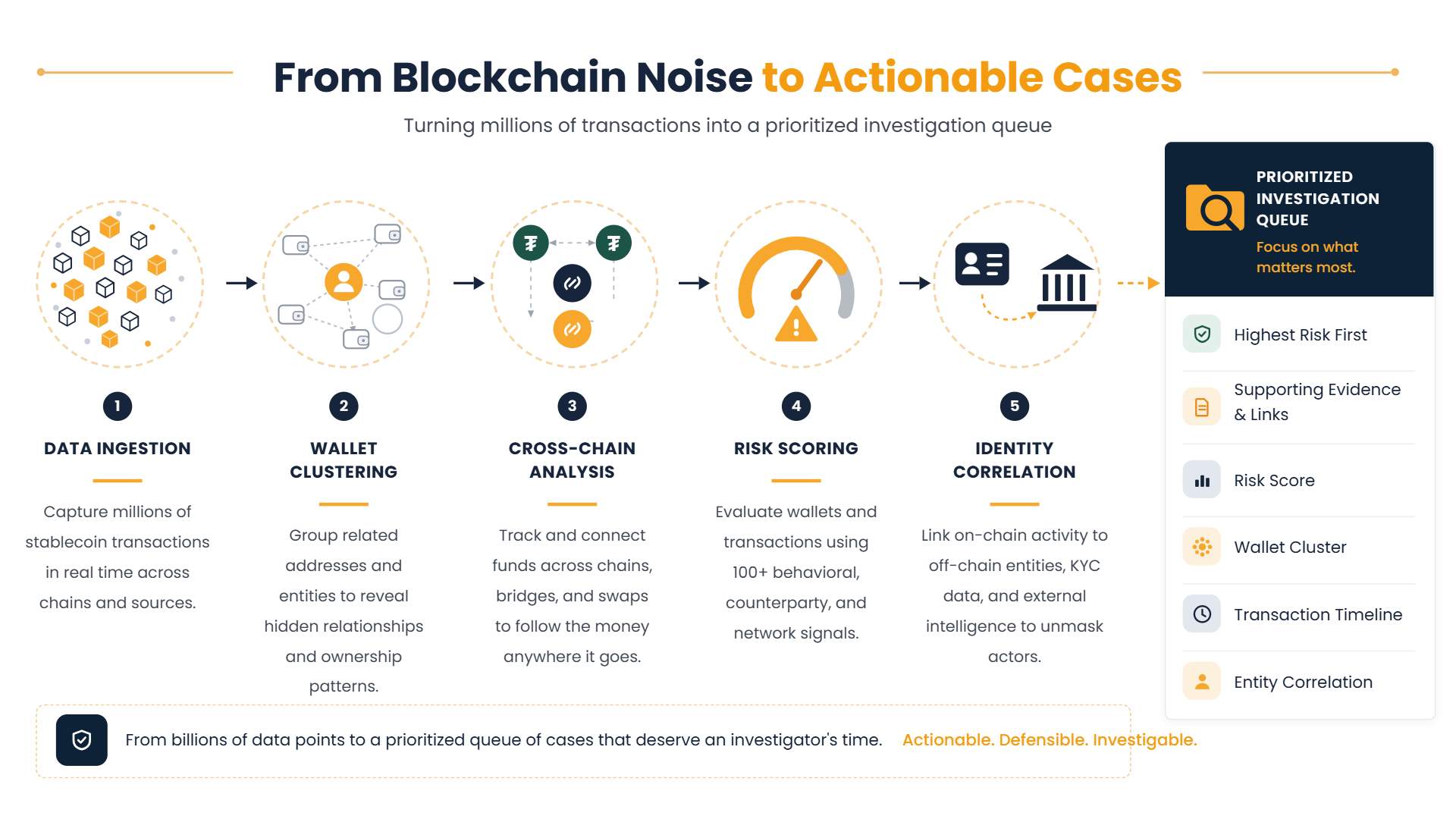
The challenge, therefore, is no longer collecting blockchain data. It is transforming billions of transactions into a manageable stream of high-confidence investigative leads.
How mLogica Approaches This
For tax authorities, mLogica's Taxable Events platform is built to support exactly this shift, moving from reactive investigations to continuous, risk-scored monitoring. Rather than simply presenting dashboards, the platform functions as a case-management workspace where transactions and wallets are continuously scored, prioritized, and surfaced into an investigation queue. This enables caseworkers to focus on the highest-risk activity instead of spending valuable time sorting through millions of transactions themselves.
Behind the scenes, the platform is powered by Archon Insights, mLogica's blockchain intelligence layer, which combines on-chain and off-chain data to deliver wallet clustering, entity resolution, de-anonymization, and risk-scoring capabilities that support this investigative workflow.
For a broader look at how governments can close the crypto tax gap through advanced analytics, see our related article: Closing the Crypto Tax Gap: Why Governments Need Advanced Analytics.
The Bottom Line
Stablecoins have become a core component of global financial infrastructure, and their tax risk profile is both distinct from and, in many ways, higher than that of the broader crypto market. Waiting for the next reporting cycle is no longer a viable strategy for tax authorities. Continuous, stablecoin-aware monitoring is quickly becoming the baseline for effective digital asset tax administration.
Ready to see how continuous, stablecoin-aware monitoring can strengthen your agency’s tax compliance and investigation capacity? Contact us to schedule a briefing with the Archon Insights team or to request a platform overview to learn how Taxable Events and Archon Insights turn high-volume blockchain data into prioritized investigative leads.
Sources
- Financial Action Task Force, Targeted Report on Stablecoins and Unhosted Wallets, March 2026:
https://www.fatf-gafi.org/en/publications/Virtualassets/targeted-report-stablecoins-unhosted-wallets.html - OECD, Crypto-Asset Reporting Framework and amended Common Reporting Standard:
https://www.oecd.org/en/about/news/announcements/2024/10/crypto-asset-reporting-framework-and-amended-common-reporting-standard-oecd-releases-it-format-for-transmitting-information-and-issues-interpretative-guidance.html - CoinDesk, "Circle's USDC Is Leaving Tether Behind in the Stablecoin Volume Race," July 2026:
https://www.coindesk.com/business/2026/07/06/circle-s-usdc-is-leaving-tether-behind-in-the-stablecoin-volume-race - Forbes, "Stablecoin On-Chain Volume Reaching $7 Trillion, Surpassing ACH Network," July 2026:
https://www.forbes.com/sites/digital-assets/2026/07/19/stablecoin-on-chain-volume-reaching-7-trillion-surpassing-ach-network/ - World Bank, Remittance Prices Worldwide, Issue 54, September 2025:
https://remittanceprices.worldbank.org/sites/default/files/2026-04/RPW_main_report_and_annex_Q325.pdf - mLogica, Closing the Crypto Tax Gap: Why Governments Need Advanced Analytics:
https://www.mlogica.com/resources/blogs/closing-the-crypto-tax-gap-why-governments-need-advanced-analytics - "Following the Money: Stablecoins, Crime Tracking, and Public-Private Compliance" (Brazil USDT tracing case and 2024 Tether wallet-freeze figures):
https://www.mmerge.io/on-stage/following-the-money-stablecoins-crime-tracking-and-public-private-compliance
Suyash Singh – Product Manager - Analytics Solutions
- Share on