




































Peel-Chain Behavior: Why It Complicates Attribution and How to Respond

George Petrovic – Product Owner Platform Strategy & Digital Assets - mLogica
A stolen wallet rarely moves in one transaction. It moves in hundreds.
Peel chains are one of the oldest laundering techniques on Bitcoin, and one of the hardest to shake. The mechanics are almost boring: a large balance gets split, again and again, into a small payment and a larger remainder, until the funds are too fragmented to follow by eye. That simplicity is exactly what makes the technique effective and exactly what compliance and investigation teams need to understand before they can respond to it.
What Is a Peel Chain?
Bitcoin doesn't let a wallet spend “part” of a balance the way a bank account does. A UTXO (unspent transaction output) has to be spent whole. So, when a wallet holding 2 BTC wants to send 0.2 BTC to someone, the transaction creates two outputs: the payment (0.2 BTC) and the change (1.8 BTC), sent back to a new address the sender still controls.
A peel chain is what happens when that pattern repeats, hop after hop, often on autopilot: a small amount peels off at every step while the bulk of the balance cascades forward into a freshly generated change address. A single deposit can branch into hundreds, sometimes thousands of transactions before the funds are fully dispersed, usually toward exchanges, mixers, or other cash-out points.
Why It Complicates Attribution
Peel chains aren't hard to see on the ledger the blockchain is public. They're hard to interpret, for three reasons.
- Volume overload. Automating a peel chain can generate hundreds of hops in hours. Reviewing that manually, transaction by transaction, isn't a realistic workflow and the sheer number of new addresses buries the handful of hops that actually matter.
- Threshold evasion. Each individual peel is small by design, often small enough to sit below the transaction-size thresholds that trigger AML alerts. The activity looks unremarkable one hop at a time; the pattern only becomes visible in aggregate.
- Heuristic confusion. Change addresses aren't inherently suspicious legitimate wallets generate them on nearly every transaction. The standard “closing loop” logic some tools use linking the end of a chain back to its start through a shared later transaction can also fail quietly: misclassify one hop's change output as a payment, or vice versa, and every inference downstream of that point is compromised. That's a probabilistic call, not a certainty, and it needs to be treated that way.
How to Respond
Investigators who deal with peel chains successfully tend to shift how they work, not just which case they open next.
- Trace by pattern, not by transaction. Look for the signature repeated, shrinking outputs, tight timing, and high hop count rather than reviewing each hop in isolation.
- Anchor to volume, not the individual peel. A 0.05 BTC transfer means little alone. The same transfer as hop 40 of a chain that started at 30 BTC means a great deal.
- Focus on the off-ramp. Peel chains exist to get funds somewhere, an exchange, a mixer, or a service that converts to fiat. Tracing forward to that destination is usually more productive than trying to map every intermediate hop.
- Treat change-address heuristics as evidence, not proof. Validate a suspected change link against more than one signal output pattern, timing, and a later co-spend before an escalation is built on it.
How Archon Insights Supports This Workflow
Archon Insights is built to turn that raw, hop-by-hop data into something an investigator can actually work with without opening every transaction one at a time.
Address Explorer Change Tab
Address Explorer classifies every allocation an address receives as Trade, Change, or Coinbase, and lets an analyst view an address's full Change-type allocation history amount, timing, and volume in one place instead of one transaction at a time.
Small example: An analyst scopes a suspect address in Explorer and opens the Change tab. Instead of reviewing forty separate transactions, the tab surfaces every Change-type allocation for that address at once, amount and timing side by side the peel-chain signature (repeated, shrinking, change-type outputs) becomes visible as a pattern rather than forty isolated data points.
Address TopN
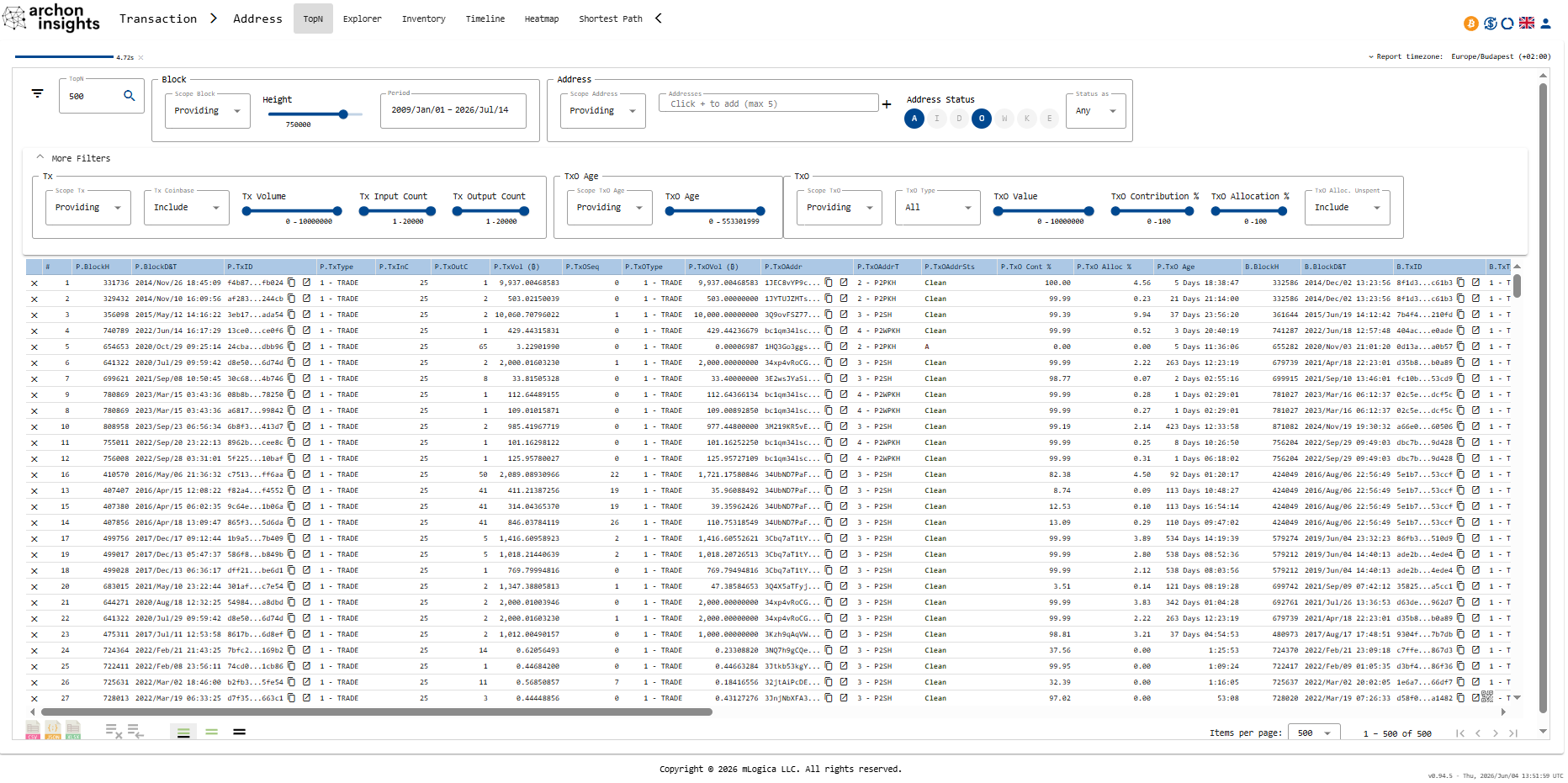
Address TopN ranks transactions by volume for a scoped address and tags each one by economic type: Trade, Change, Fee, or Coinbase across up to 10,000 rows in a single query in seconds.
Small example: Instead of opening each of 300 downstream hops to check whether it's a change link, an analyst runs Address TopN across the cluster and filters for Change-type Bucket transactions, ranked by size. What would take hours of manual review becomes a single sortable list a long peel chain stands out as a run of decreasing Change-type amounts rather than a haystack of individual transactions.
Upstream and Downstream Dependency
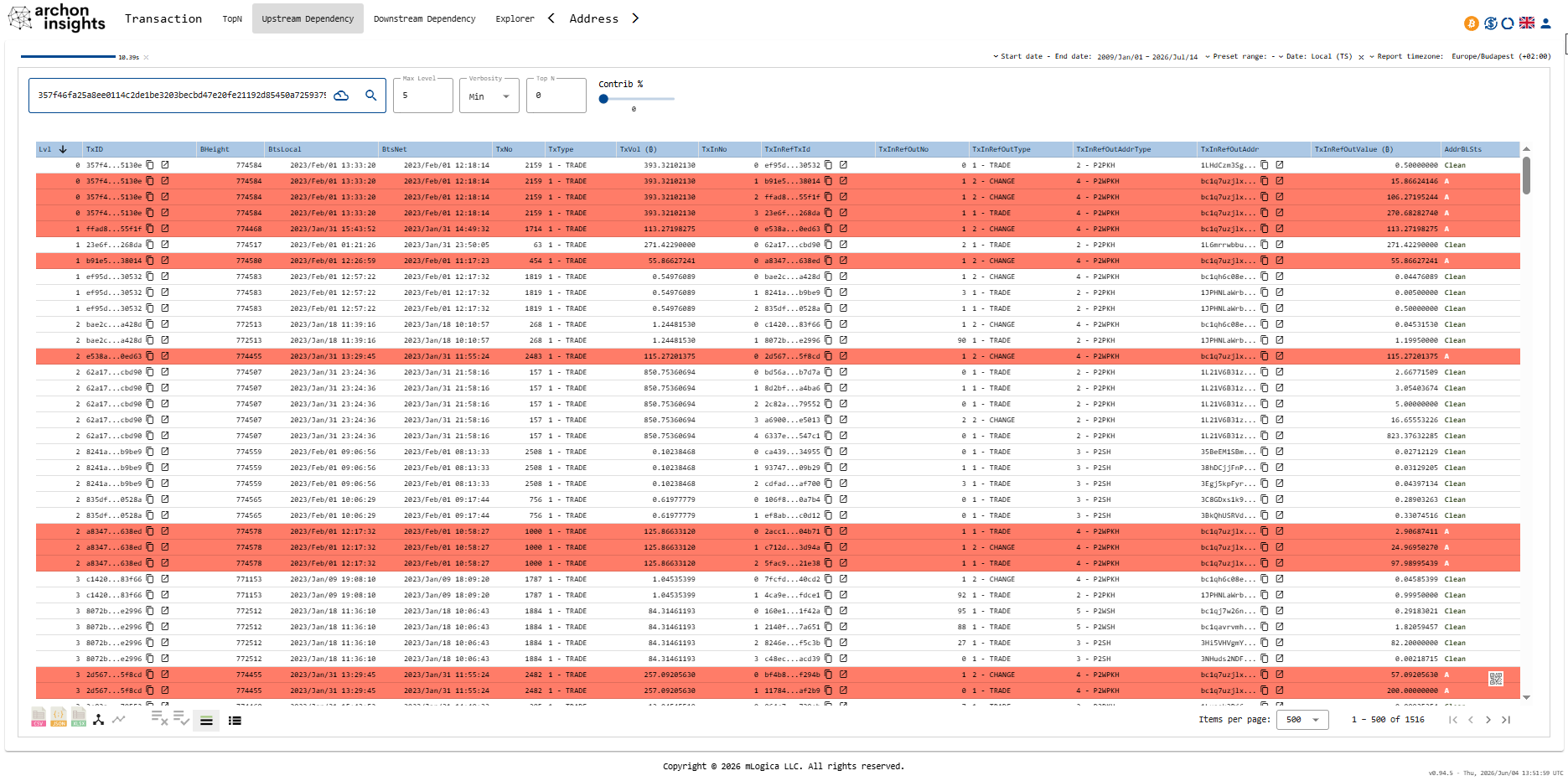
Dependency tools trace funds hop by hop from a chosen transaction Upstream to establish where the money originated, Downstream to follow where it went, with every hop tagged by level (its distance from the starting point) and a configurable depth limit.
Small example: Starting from the first peeled output, an analyst runs Downstream Dependency with a defined hop limit and lets it trace forward automatically. Instead of clicking through each new change address by hand, the tool surfaces the chain's actual destination, an exchange deposit address, a consolidation wallet, and shows exactly how many hops separate the starting point from the off-ramp.
Address Heatmap
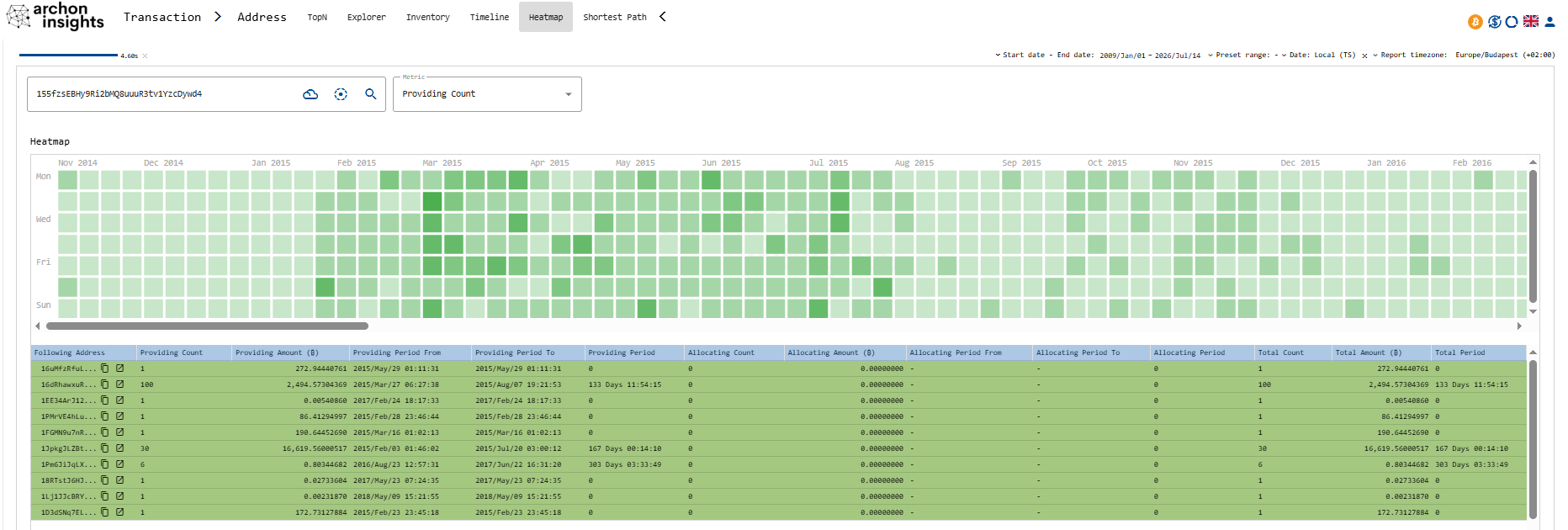
Heatmap converts an address's transaction history into a day-by-day activity view, which makes the burst pattern typical of automated peeling hundreds of hops concentrated into a few hours visible at a glance.
Small example: A single dark cluster of days on the calendar, against an otherwise quiet history, is often the fastest way to flag that a wallet's activity was scripted rather than organic before an analyst commits time to a full trace.
The Strategic Advantage
None of this replaces investigator judgment. Archon Insights is decision support. What it changes is the cost of looking. A peel chain that would take an analyst hours to map by hand, one transaction at a time, becomes a pattern that's visible in minutes: change-type allocations grouped instead of scattered, hop-by-hop provenance traced automatically instead of manually, and activity bursts flagged before a single hop is opened.
That matters in two ways. First, speed: cases move from alert to a documented decision faster, without the manual tracing that eats analyst time on chains that turn out to be routine consolidations. Second, defensibility: because every hop, level, and change classification is captured in the export, the resulting case file shows exactly how the conclusion was reached, which is what stands up under audit or regulatory review, not just what an analyst remembers noticing.
Peel chains work by exhausting attention. Archon Insights is built to make sure that's the one resource investigators don't run out of.
Contact us to learn more about Archon Insights.
George Petrovic – Product Owner Platform Strategy & Digital Assets - mLogica
- Share on