





































Proof Before Cutover: The Evidence Standard for Mainframe Modernization

Yesh Singhal, Vice President, Strategic Solution Services | mLogica
Cutover Confidence Is Not a Feeling
The systems most leaders want to modernize are often the same systems the business cannot afford to get wrong. IBM reports that mainframes handle almost 70% of the world’s production IT workloads, while Kyndryl’s 2025 State of Mainframe Modernization survey found that 56% of respondents had increased their use of the platform in the prior year. Mainframe modernization is therefore not simply a technology refresh. It is a production-risk decision.
The standard should not be faster for conversion alone. For mission-critical systems, it should be proof-driven modernization built on evidence-based cutover readiness.
Proof, in this context, does not mean a guarantee of zero defects or a substitute for regulatory certification. It means a governed, reproducible body of evidence showing that defined business, technical, operational, security, and risk-acceptance criteria were evaluated - with exceptions and residual risks explicitly recorded and approved.
A converted application, a successful demonstration, or a set of passing functional tests does not establish that standard by itself. Traditional QA often samples expected functions. Mission-critical modernization requires broader source-to-target validation across business behavior, data, interfaces, batch processing, security, reporting, and operations, at a depth proportionate to the risk of the workload.
For CIOs, CTOs, CFOs, risk officers, audit leaders, and business owners, the decisive question is no longer only, “Did the program modernize the system?” It is, “What evidence supports the decision to place the modernized system into production?”
Why Proof Belongs at the Release Gate
Mainframe modernization has traditionally been measured through technical progress: code translated, data moved, environments provisioned, test cases passed. Those milestones matter, but none of them independently establishes production readiness.
A platform can pass functional testing in a controlled environment and still fails when the business day begins. Consider a claims platform that produces the correct aggregate payment total during testing but handles a subset of reversed claims differently under concurrent processing. The total can be reconciled while claim-level discrepancies remain. A green dashboard at the aggregate level can therefore conceal a material difference in business behavior.
Regulatory and control frameworks reinforce the need for documented evidence, although they should not be overstated as prescribing a specific modernization method. The EU Digital Operational Resilience Act (DORA), effective January 17, 2025, establishes requirements for ICT risk management, resilience testing, incident reporting, and third-party risk for in-scope financial entities. FFIEC guidance similarly emphasizes resilience and risk-management controls for financial institutions, while FedRAMP requires structured security assessment and ongoing authorization evidence for applicable cloud services. A modernization evidence package can support these obligations; it does not replace them.
For systems supporting banking, claims, payments, benefits, logistics, billing, public-sector operations, or patient data, the release decision should be backed by evidence that is specific enough for technology, business, risk, audit, compliance, and operations stakeholders to challenge and approve.
What an Evidence Package Must Answer
An evidence package is a governed record that brings together the information required to support a production promotion decision. It is not a status report and it is not a claim that risk has been eliminated. It is the documented basis for accepting the remaining risk and authorizing release.
At minimum, it should answer five executive questions:
- What changed across code, data, interfaces, batch, security, reporting, and operational procedures?
- Why did it change, which rules or mappings governed the change, and who approved them?
- What evidence demonstrates source-to-target business and behavioral equivalence within agreed tolerances?
- Which exceptions, defects, reconciliations, and residual risks remain, and who reviewed or accepted them?
- What is the documented basis for promoting the modernized system to production now?
This is the evidence spine of proof-driven modernization. It links the source baseline, transformation decisions, test results, reconciliations, exceptions, operational-readiness results, approvals, and release decision into one governed chain. Without that spine, a program can demonstrate activity. With it, stakeholders can evaluate the evidence behind the cutover decision.
A Practical Proof Before Cutover Flow
Proof should be built progressively, not assembled in a rush immediately before go-live. Evidence is generated and accumulated throughout the modernization lifecycle, then consolidated at the release gate. The flow begins with an agreed baseline, moves through transformation validation and automated testing, establishes equivalence through parallel run or controlled comparison, verifies operational readiness, and ends with an evidence-based release decision.
The workflow below illustrates how evidence is accumulated, validated, and linked throughout the modernization lifecycle.
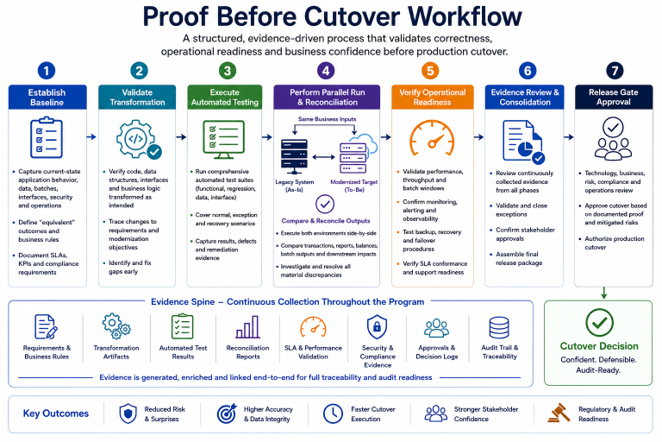
Figure 1. Evidence is not a final event at go-live; it is built progressively from baseline through release gate.
Baseline > Transformation Validation > Automated Testing > Parallel Run and Reconciliation >
Operational Readiness > Evidence Package > Release Gate Approval
The outcome is not simply a migrated system. It is a documented, challengeable basis for deciding that the modernized environment is ready for production - including the tolerances, exceptions, and residual risks attached to that decision.
Parallel Run Turns Confidence Into Comparison
Parallel run is one of the strongest ways to compare legacy and modernized behavior because it places the two environments against the same or equivalent business inputs before the legacy system is retired. Where direct side-by-side execution is operationally feasible, it shifts the discussion from opinion to observable comparison.
Parallel run is not universally simple. Workloads may depend on external systems, time-sensitive state, privacy restrictions, or events that cannot safely be executed twice. Where direct parallel execution is impractical, controlled replay, shadow processing, or isolated comparison can apply the same principle: obtain credible source-to-target evidence at the level the business risk requires.
The comparison must be designed around business outcomes, not only technical records. Row counts and pass/fail tests are useful, but a stronger standard asks whether the same business event produces the expected decision, updates the correct logical entities, feeds required downstream processes, preserves sequencing and controls, and meets agreed service levels.
This is where mLogica TRAK*M AutoTest becomes important. AutoTest is designed to automate source-to-target validation and comparison across transformed workloads, capturing expected and actual outcomes, reconciliation results, exceptions, remediation, and rerun evidence. The point is not to create more testing artifacts. It is to create a repeatable evidence trail from observed difference to resolved cause.
SLA Validation and Operational Readiness Are Part of Correctness
One common cutover mistake is treating performance as separate from correctness. For a mission-critical system, correctness is not only whether the answer is right; it is whether the system produces the right answer within the operating conditions the business requires.
If a claims process produces the right result after the payment window closes, the business outcome still fails. If an eligibility system calculates accurately but misses a nightly interchange deadline, downstream operations can fail. If a banking platform reconciles correctly but cannot sustain the defined peak transaction profile, the modernization risk has moved from conversion into production operations.
SLA and operational-readiness validation therefore belong inside the evidence package. The evidence should address batch windows, response time, throughput, concurrency, restart and recovery, exception processing, monitoring, support readiness, and security controls. Testing should use production-representative volumes and failure scenarios with documented assumptions and tolerances. It cannot guarantee future production behavior, but it can make the release decision materially more defensible.
AI Can Accelerate Evidence, But It Cannot Replace It
AI can accelerate discovery, summarize legacy logic, identify dependencies, generate candidate test cases, classify anomalies, and help analysts navigate large application portfolios. In an environment where deep mainframe expertise is scarce and estates are complex, that acceleration has substantial value.
But the role of AI must be defined precisely. The modernization program should not confuse model output with production evidence, and it should not treat an unconstrained generative model as the authority for a release decision.
mLogica uses domain-specific Small Language Models (SLMs) focused on production code, legacy languages, data structures, and modernization patterns. They bring specialized intelligence into controlled workflows for analysis, classification, mapping, transformation support, test design, and anomaly triage. They do not replace governed execution, validation, or human approval of material exceptions.
The distinction is critical: the SLM provides domain intelligence; the deterministic pipeline governs production transformation. Once rules, mappings, configurations, and versions are approved, the controlled execution path is designed so the same governed inputs produce the same governed outputs. Free-form model output is not treated as the production result. This separation supports reproducibility, traceability, and repeatable remediation.
AI-generated analysis is still not proof on its own. An SLM can identify what should be tested or help interpret a discrepancy; the governed validation process must execute the comparison, trace the cause, and rerun the corrected transformation before the evidence package is updated.
The operating principle is simple: AI accelerates. Deterministic execution controls. Validation proves. That combination allows AI to reduce manual effort without asking risk, audit, or business owners to trust an opaque model output at cutover.
The Cutover Conversation Should Change
Modernization buyers should evaluate more than conversion speed. They should ask how evidence is produced, how transformation rules are versioned, how exceptions are managed, how source-to-target behavior is reconciled, how operational commitments are tested, and how approvals are recorded.
A systems integrator may provide program scale. A cloud provider may provide target infrastructure. A database platform may provide the landing zone. Those capabilities are important, but none by itself answers the release question. The program still needs a control layer that connects transformation, validation, reconciliation, exception management, operational readiness, and release governance.
For mission-critical transformation, proof-driven modernization provides a stronger operating standard because it makes the basis for accepting risk explicit, reproducible, and reviewable. That can reduce avoidable rollback risk and repeated manual validation, improve auditability, and give business owners a clearer basis for approving release.
Proof Is the Modernization Decision Gate
Organizations need greater agility, modern platforms and skills, and a path to use AI and cloud services without compromising core operations. But speed without evidence moves uncertainty closer to the business.
The takeaway is this: proof - not confidence language - should be the modernization decision gate.
At cutover, the organization should be able to produce a documented chain of evidence showing what changed, which rules governed the change, how business and behavioral equivalence were evaluated, which operational thresholds were met, which exceptions were resolved or accepted, who approved the release, and what residual risks remain.
That is more demanding than “the conversion worked.” It gives technology, business, risk, and audit stakeholders the same factual basis for the decision that matters most: whether the modernized system is ready to operate.
Ready to Validate Your Cutover Strategy?
Moving to a proof-driven modernization model requires aligning technology, business, and audit criteria well before go-live. Schedule a 30-minute modernization readiness assessment with mLogica to review your validation strategy, identify missing evidence, and build a defensible path to production.
About the Author: Yesh Singhal is Vice President, Strategic Solution Services at mLogica. He is a senior technology and consulting leader with more than 25 years of experience helping organizations navigate enterprise modernization, cloud migration, technology transformation, and large-scale technology delivery.
Yesh Singhal, Vice President, Strategic Solution Services | mLogica
- Share on