




































Reporting Quality: Why Blockchain Investigations Fail (And How Archon Insight Changes That)
George Petrovic – Product Owner Platform Strategy & Digital Assets - mLogica
The Problem Nobody Talks About
It starts quietly. An investigator submits a report on a suspicious address. Their supervisor reviews it, approves it, escalates it. Two weeks later, another investigator examines a nearly identical transaction pattern and reaches a completely different conclusion. Same data. Different decision.
A week after that, an auditor asks: “Why was this one escalated but that one dismissed?” There’s no good answer. Just analyst notes. Spreadsheet screenshots. Tribal knowledge.
This is the industry’s dirty secret: analyst variance. It’s not visible in your dashboard. It doesn’t appear in a single case. But when you scale across hundreds or thousands of investigations, it becomes expensive, visible, and—when regulators arrive—urgent.
The cost is staggering, but not where you’d expect.
Most compliance operations don’t lose money in one catastrophic incident. They bleed resources through friction: alerts reviewed multiple times, rework loops between analyst and supervisor, escalations delayed by follow-up questions, audit reconstruction consuming 45-60 minutes per case. One large cryptocurrency exchange we work with estimated they were burning 300+ analyst-hours monthly just on rework and audit follow-ups.
The fundamental problem isn’t that investigators can’t see the blockchain. It’s that they can see too much, without a systematic way to explain what matters and why.
Why Traditional Blockchain Tools Miss the Point
The market offered a solution: more visibility. Better data. Faster queries. Traditional blockchain tools excel at showing you what’s on the blockchain—transaction flows, entity clustering, risk tagging. They’re powerful surveillance platforms.
But visibility isn’t the same as defensibility.
A compliance team can now see that a transaction routes through a mixer, touches a sanctioned address, and emerges on a major exchange. Visibility solved. But the investigator still has to answer: “Why did you decide this was worth escalating?” The supervisor still has to explain the decision to legal counsel. The auditor still asks: “Could another analyst reach a different conclusion?”.
Visibility platforms give you more data to answer these questions. They don’t help you structure the investigation itself so the answers are consistent, repeatable, and defensible.
That gap—between visibility and defensibility—is where Archon Insight enters the problem.
The Archon Difference: From Surveillance to Structure
Archon Insight is built on a fundamentally different premise: structured investigation is more valuable than raw visibility.
Instead of optimizing for “how much can we see,” Archon optimizes for “how can we investigate the same case the same way, every time?”
This distinction matters because it addresses the real cost center in blockchain investigations: not the technical capability to trace transactions, but the operational discipline to trace them defensibly.
Archon does this through a five-phase workflow that mirrors how investigations actually happen:
Rank → Inspect → Trace → Contain → Contextualize
Each phase serves a specific purpose. Each phase generates a specific kind of evidence. Together, they create an investigation that multiple analysts can reproduce, supervisors can defend, and auditors can verify.
This isn’t flashier than competitors. It’s more boring. And that’s exactly the point.
Phase 1: RANK — Starting from Materiality, Not Hunches
The first decision in any investigation is the hardest: which cases matter?
Most teams make this decision intuitively. An analyst sees an alert, feels it’s important, escalates it. Another analyst sees a similar alert, feels differently, dismisses it. Same signal. Different response.
Archon’s TopN tools force a different question: “What makes this case rank above all the others in my portfolio?”
Instead of intuition, you answer with data: - “This address processed $101.8M in 30 days (top 5% by volume)” - “It matched our OFAC watchlist with 12 designated predecessors” - “It shows peel-chain consolidation patterns across 45 identical transactions”
Notice the shift: you’re not claiming the case is suspicious. You’re claiming it ranks highly by specific, comparable criteria.
This is crucial because:
- It’s reproducible. Another analyst using the same TopN filters on the same dataset gets the same ranking.
- It’s defensible. When an auditor asks “why this one?”, you point to metrics, not instinct.
- It’s consistent. All cases are evaluated against the same thresholds, not different analysts’ hunches.
Archon Insight makes ranking the structured entry point to every investigation.
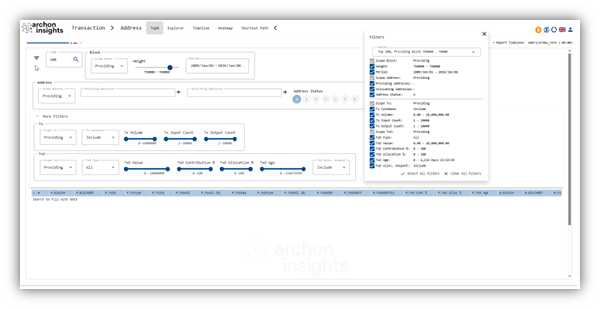
TopN ranking tool: defensible triage by materiality, volume, and policy triggers
Phase 2: INSPECT — Separating Facts from Storytelling
Once you’ve ranked a case, the next trap is easy to fall into: mixing observation with interpretation.
An investigator sees a transaction with unusual structure. They immediately form a hypothesis: “This looks like a peel-chain consolidation.” They build the narrative around that hypothesis. They find evidence that supports it. They miss evidence that contradicts it. Confirmation bias sets in.
Archon’s Explorer tools force a different discipline: freeze facts before forming hypotheses.
Facts are observable, verifiable against the blockchain: - “The address processed 45 transactions” - “Every transaction shows exactly 2 outputs” - “Output amounts are round numbers: 1,000 BTC, 950 BTC, 500 BTC, 600 BTC” - “Activity concentrated in a 3-week window, then dormant 8+ months”
Hypotheses are interpretations to be validated: - “This mechanical precision could indicate programmed fund management” - “The burst timing may suggest campaign-style operation” - “The use of a clean-status intermediary could be consistent with money laundering layering”
Notice the language: “could,” “may,” “consistent with.” Not “proves” or “indicates.” This invites further validation rather than claiming certainty.
When you report this way—facts separated from hypotheses, explicitly labeled—something powerful happens: different supervisors, auditors, and partners can reach different conclusions from the same facts, and that’s healthy. What they can’t do is dispute the facts themselves.
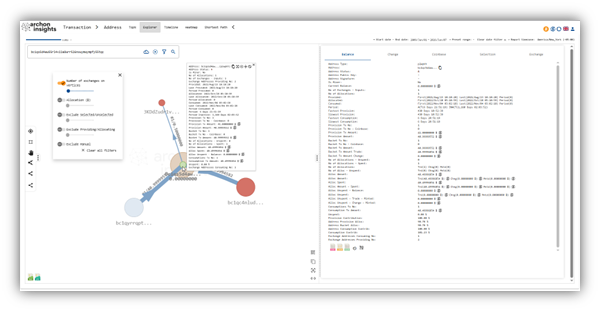
Address Explorer: surface transaction patterns, counterparties, and behavioral relationships
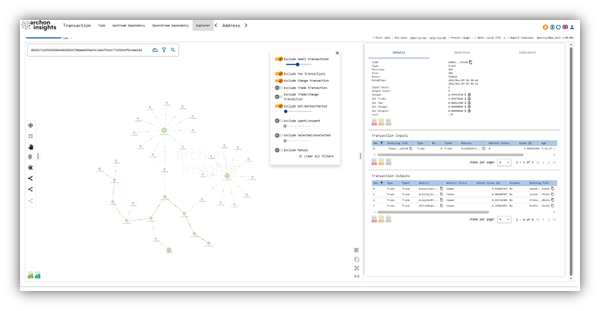
Transaction Explorer: map inputs, outputs, amounts, and transaction structure to identify patterns
Phase 3: TRACE — Asking Bounded Questions
Here’s where most blockchain investigations go sideways: “How far does this go?”
Without bounds, investigators follow graphs infinitely. They find tangential addresses. They chase weak signals. They lose focus. Time-to-decision stretches from days to weeks.
Archon’s Dependency tools (Upstream/Downstream Dependency, Shortest Path) force explicit constraints:
- “Upstream depth: 5 hops max, marked sources only, 30-day window” - Result: 312 unique predecessors, 47 marked
- “Downstream depth: 3 hops max, all outputs, starting from subject address” - Result: 127 downstream addresses, 23 sanctioned
The constraints aren’t arbitrary. They’re designed to answer a specific question: “How much exposure does this create?” The constraints prove you asked a bounded question and got a bounded answer—not that you got lost following the graph. This is radically different from “we traced it downstream.” Archon’s approach is: “We traced downstream with these specific parameters, found these specific results, and here’s why we stopped there.”
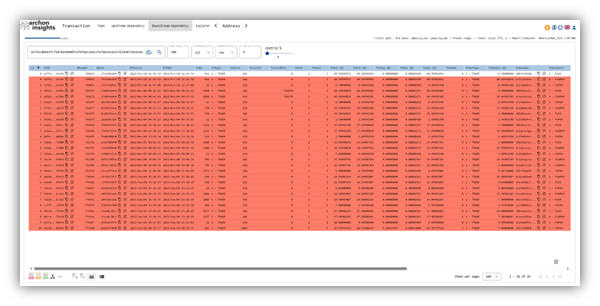
Downstream Dependency: trace money flow and identify contagion with explicit constraints
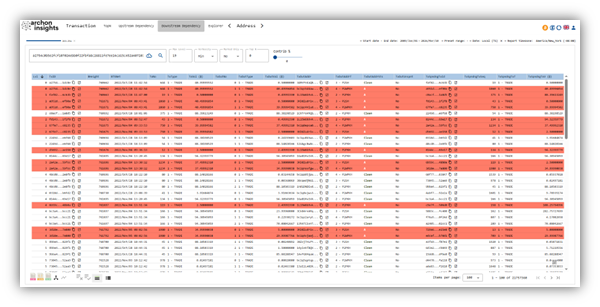
Downstream traversal results: quantified scope showing transaction paths and affected addresses
Phase 4: CONTAIN — Connecting Findings to Policy
This is where most investigations drift from evidence to opinion.
An investigator finds marked upstream sources, downstream sanctions exposure, and says: “This should escalate.” A supervisor asks: “Why?” The investigator lists the findings. The supervisor says: “But our last case had similar findings and didn’t escalate. Why is this different?”
Now you have a consistency problem. Not a technical one—a governance one.
Archon forces the critical question: What policy threshold does this case trigger?
Not “does it seem important,” but “does it meet our documented escalation criteria?”
Your escalation policy might say: - Criterion 1: Direct OFAC matching → escalate - Criterion 2: 3+ marked predecessors → escalate - Criterion 3: Marked downstream propagation → escalate
This case triggers criteria 2 and 3. Policy says: escalate. Done.
The decision wasn’t discretionary. It was policy-driven. That changes everything for auditors, supervisors, and future analysts.
Phase 5: CONTEXTUALIZE — Building the Audit-Ready Narrative
Finally, you synthesize everything into a narrative that someone reading it 6+ months later can understand:
“Address bc1q7uz… processed $101.8M across 45 transactions in a 3-week campaign (Jan 2-23, 2024). The consistent peel-chain structure (2 outputs per transaction, round-number trade amounts, 3-week burst followed by 8 months dormancy) aligns with programmed consolidation behavior. Upstream exposure: 47 marked sources. Downstream exposure: 23 OFAC-designated addresses. This case triggers escalation thresholds (2) and (3) per policy 4.2. Recommendation: Senior compliance review.”
Notice what you’ve built: a decision trail. Anyone reading this—supervisor, auditor, partner, future investigator—can follow the logic. They can challenge the facts. They can debate the interpretation. But they can’t claim the investigation was ad-hoc or inconsistent.
Why This Workflow Matters More Than You Think
Here’s what changes when you implement this structure:
Time-to-decision drops 20-30%. Supervisors don’t need follow-up questions. The methodology is documented. The policy mapping is explicit. Cases move through review in days, not weeks.
First-pass quality improves. Cases that go through proper Rank → Inspect → Trace → Contain → Contextualize structure don’t get reversed on supervisor review. Different analysts reach the same conclusions because they followed the same process.
Audit reconstruction time collapses. Instead of 45-60 minutes rebuilding a case narrative per audit sample, auditors can follow your structured logic in 10-15 minutes. When you’re audited on hundreds of cases, this is significant.
Analyst variance shrinks. When all investigators use the same ranking criteria, the same fact-versus-hypothesis discipline, the same dependency constraints, and the same policy mapping—they reach the same conclusions on similar cases. That’s operational maturity.
Rework loops decline. Methodology documentation means fewer supervisor comments like “can you clarify why you decided this?” The structure already answers that.
These aren’t writing improvements. They’re operational efficiency improvements. Reporting quality becomes a proxy for investigation quality because the structure of your report reveals the structure of your investigation.
The Hidden Cost of Not Having This
Let’s talk about the opposite scenario. You’re using a traditional forensic platform. You can see everything. But you haven’t implemented structured investigation workflow.
What happens?
Case 1: Investigator A reviews address X. Sees marked predecessors. Escalates.
Case 2: Investigator B reviews address Y (similar profile). Sees marked predecessors. Closes it as low priority.
Audit: “Why the difference?”
Answer: Different analysts have different risk tolerances.
Auditor response: “That’s a control failure.”
That’s not a technology problem. That’s a discipline problem. And visibility tools don’t solve discipline problems—they often make them worse because they give you more data to get confused by.
Archon’s structural approach solves the discipline problem. Every investigation follows the same path. Every analyst answers the same questions. Every report documents the same logic.
The Competitive Gap
There are known world-class crypto surveillance platforms. If your question is “show me all the ways this address could be connected to illicit activity,” they’ll show you everything.
Archon answers a different question: “How do I investigate this address the same way every time, document my reasoning defensibly, and ensure two analysts reach the same conclusion?”
That’s not flashier. It’s not sexier. But it’s more valuable for compliance operations that need to scale consistently, defend decisions under audit, and reduce analyst variance.
One tool maximizes visibility. The other maximizes defensibility. Both matter. But most compliance programs are drowning in visibility and starving for defensibility.
Building the Discipline
Here’s the practical part: how do you make this stick?
1. Use the Rank → Inspect → Trace → Contain → Contextualize structure on every case.
Don’t treat it as optional. Make it your investigation template. Every case follows the same five phases. Every phase generates the same kind of output.
2. Require fact/hypothesis separation at intake.
As part of your initial triage decision, document three things: (1) observable facts, (2) testable hypotheses about what those facts mean, (3) what would change the decision. This single discipline reduces rework dramatically.
3. Make tracing bounded by default.
When investigators use Dependency tools, always define depth limits, time windows, and scope constraints before you run the query. Document why you chose those bounds. This prevents “graph wandering” and speeds decision-making.
4. Export and attach artifacts.
Don’t just describe what Archon Insight found—include the exports. XLSX files of ranking results. CSV exports of dependency traversals. Shareable query URLs. Let reviewers verify your work directly.
5. Map every finding to documented escalation policy.
Not “this looks important,” but “this triggers policy threshold X.” Make policy explicit. Make mapping explicit. Remove subjectivity.
6. Measure what actually matters.
Track time-to-decision, first-pass quality rate, rework loops per case, and audit reconstruction time. These metrics force discipline. They show progress to leadership. “We reduced audit reconstruction time from 45 to 12 minutes per case” is far more powerful than “we’re being more careful.”
The Payoff: What Changes When You Get This Right
Organizations that implement structured investigation workflows see measurable improvements within 90 days:
- Time-to-decision: 20-30% improvement
- First-pass quality: 35-40% reduction in cases requiring rework
- Audit reconstruction: 60-70% faster (from 45-60 min to 12-15 min per case)
- Analyst variance: 30-35% reduction in inconsistent decisions on similar cases
- Escalation precision: Higher signal quality; fewer false positives consuming review capacity
But the deeper payoff is organizational: you shift from “we hope we’re consistent” to “we know we are.”
Partners trust your escalations because they’re repeatable. Supervisors defend your decisions because the logic is documented. Investigators build on your work without starting from scratch. Auditors see controlled decision-making, not analyst opinions.
That’s worth far more than another data visualization.
Conclusion: From Visibility to Defensibility
The next evolution in blockchain investigations isn’t about seeing more. It’s about investigating more consistently and defensibly.
Your compliance program doesn’t need another visibility tool. The blockchain is already transparent. What it needs is a repeatable, auditable methodology that scales across analysts, survives regulatory scrutiny, and dramatically reduces the hidden cost of analyst variance.
That’s exactly what Archon Insight is built for.
It doesn’t replace your existing surveillance platforms — it structures how you use them. It doesn’t let you investigate more cases — it helps you investigate the same cases the same way, every time.
It doesn’t just speed up reporting — it builds operational maturity.
Rank → Inspect → Trace → Contain → Contextualize isn’t just a workflow. It’s how you turn reporting quality into a competitive advantage.
Ready to see it in action?
Want to see how the Rank → Inspect → Trace → Contain → Contextualize workflow looks with real data?
Contact us to book a 30-minute demo of Archon Insight
The teams that win in crypto compliance aren’t the ones with the most data. They’re the ones with the most disciplined process.
George Petrovic – Product Owner Platform Strategy & Digital Assets - mLogica
- Share on