




































The Minority Report era for Tax Intelligence

Ketan Karia – VP, Analytics EMEA Blockchain for VAT
In Steven Spielberg's Minority Report, a specialized police unit prevents crimes before they occur using predictive intelligence. While tax authorities are not in the business of "pre-crime," the underlying idea has become remarkably relevant. By combining AI, integrated government data, and advanced risk scoring, modern revenue agencies can identify taxpayers and transactions that exhibit the earliest signs of fraud, allowing them to intervene before fraudulent refunds are paid, revenue disappears, or complex evasion schemes take hold. Predictive tax intelligence is turning science fiction into a practical tool for smarter, fairer tax administration.
For decades, tax authorities have fought fraud by looking backwards. Audits were triggered after tax returns were filed, investigations began only after suspicious refunds were paid, and enforcement relied heavily on manual reviews and random inspections. By the time fraud was identified, the revenue had often disappeared.
Today, that approach is no longer sufficient.
Digital transactions, e-invoicing, fiscalization, e-commerce, cryptocurrencies, and cross-border transactions generate billions of data points every day. In addition, the authority has access to historical filings, payment patterns, industry benchmarks, and other government data from customs, courts, social security, company registrations, banking systems... the list goes on!
It is clear to see why the traditional manual tax audit process involving selection, notification, physical field examination, and case resolution, which relied heavily on paper files, manual sampling, face to face meetings with forensic tax inspectors, was not going to scale as the world digitized.
(See our previous blog on Why Tax Authorities must digitize)
So, the challenge is no longer collecting information; it is transforming that information into actionable intelligence before the tax revenue is lost.
Modern tax administrations are therefore shifting from reactive enforcement to predictive compliance, using Artificial Intelligence (AI), advanced analytics, and integrated government data to identify fraud before it happens.
The Foundation: An integrated 360-Degree View of the Taxpayer
No single dataset can reveal the full picture of taxpayer behaviour. VAT returns may show reported sales, but they cannot verify whether those sales occurred. Customs records reveal imported goods but not whether they were declared correctly for VAT purposes. Banking data reflects cash flows but not whether corresponding income has been reported.
The answer lies in integrating multiple government and third-party data sources to create a comprehensive taxpayer profile.
A modern tax authority can typically draw on some or all of the following datasets (coverage varies by legal mandate) – each with its slice of intelligence as shown in the table below:
| Data Source | Intelligence Provided |
|---|---|
| VAT, Income Tax and Corporate Tax Returns | Filing behavior, turnover, declared profits |
| E-Invoicing Systems | Invoice validation, supplier/customer matching |
| Fiscalization/POS Systems | Real-time retail sales |
| Customs & Import Declarations | Import values, commodity movements |
| Business & Beneficial Ownership Registers | Directors, shareholders, related companies |
| Banking & Payment Data | Cash flow, international transfers, merchant activity |
| Social Security & Payroll | Employment levels and payroll consistency |
| Property & Vehicle Registries | Lifestyle and wealth indicators |
| Public Procurement Systems | Government contract revenue |
| DAC8/CARF Crypto Reports | Exchange transactions and crypto holdings |
| Blockchain Analytics | Wallet clustering and attribution, DeFi activity and cross-chain transfers |
While each dataset provides its own sliver of intelligence, their combinations reveal a better picture of the taxpayers and their activities.
The larger the number of datasets, the greater the aperture into the taxpayer profile when linked together.
Together, these datasets create a 360-degree taxpayer profile, enabling tax authorities to detect inconsistencies that would never appear within a single dataset or system.
When the Data Starts Talking
The real power of analytics emerges when independent datasets are linked together.
Consider these examples where a single data source indicates nothing unusual, but with multiple data sources a different picture emerges:
- Fiscalization, e-Invoicing and VAT Returns
Fiscalization captures retail sales in real time, e-invoicing validates business-to-business transactions, and VAT returns provide the taxpayer's summary declaration. By automatically reconciling these data sources, tax authorities can detect missing invoices, under-reported sales, inflated input VAT, and fraudulent refund claims before returns are processed. This integrated approach improves compliance, accelerates legitimate VAT refunds, and enables more targeted audits, transforming VAT administration from periodic reporting into continuous transaction monitoring. - Customs, Banking and Fiscalization
Customs records show imported goods, banking data reflects cash flows, and fiscalization captures retail sales in real time. Integrating these sources enables tax authorities to reconcile imports against sales, compare bank deposits with declared turnover, and identify discrepancies that may indicate under-reporting, smuggling, or VAT fraud. Advanced analytics can automatically detect suspicious patterns and prioritize investigations. Together, these datasets provide powerful evidence to improve compliance, reduce tax evasion, and increase government revenue. - DAC8 with Fiscalization, Banking, Taxpayer filings and blockchain analytics for Crypto Compliance
DAC8 will provide tax authorities with unprecedented visibility into cryptocurrency transactions. However, exchange reports alone cannot identify all taxable events or detect sophisticated evasion techniques. By combining DAC8 data with fiscalization records, banking information, blockchain analytics, and taxpayer declarations, authorities can build comprehensive taxpayer profiles that identify undeclared crypto income and business activity. AI-driven risk scoring further prioritizes high-risk cases, enabling tax authorities to improve crypto compliance while making more efficient use of limited investigative resources. Together, AI turns transaction visibility into actionable Tax Intelligence.
AI Turns Data into Intelligence
Traditional audit selection often depends on static business rules, for example, auditing all VAT refunds above a specified threshold.
Fraudsters quickly learn these rules and adapt.
Artificial Intelligence takes a fundamentally different approach.
Machine learning continuously evaluates hundreds of taxpayer characteristics simultaneously, comparing each taxpayer against industry peers and historical behaviour. Instead of searching for a single suspicious event, AI identifies subtle combinations of indicators that together suggest elevated risk.
These models can improve continuously as new audit results become available, enabling tax authorities surface emerging fraud patterns earlier than static rules — provided the models are retrained and monitored for drift.
Graph analytics complements machine learning by uncovering hidden relationships between companies, beneficial ownership within a supply chain, bank accounts and cryptocurrency wallets, exposing organised fraud networks that conventional reporting systems cannot detect.
Investigators no longer need to decide where to begin.
The analytics platform continuously prioritises the highest-value cases based on both fraud probability and expected revenue recovery.
From Analytics to Action: Risk-Based Compliance
Analytics only creates value when it leads to the right operational response.
Rather than treating every taxpayer equally, modern tax administrations assign dynamic risk scores based on behavioural, financial, and transactional indicators.
An illustrative risk matrix to triage scarce resources to critical cases may look like this:
| Risk Score | Risk Level | Typical Action |
|---|---|---|
| 0–20 | Very Low | Routine monitoring |
| 21–40 | Low | Educational communication or automated reminder |
| 41–60 | Medium | Desk review and request for additional information |
| 61–80 | High | Targeted audit and enhanced monitoring |
| 81–100 | Critical | Immediate field investigation, refund suspension, or fraud investigation |
But more sophisticated risk matrices are used to decide tax revenue implications and enforcement strategies.
These balance non-compliance against consequence by evaluating the probability of an infraction and the financial impact of loss, prioritizing cases through likelihood and materiality. Tax authorities use these twin pillars to assign risk levels and deploy operational enforcement that includes digital as well as human forensic vigilance.
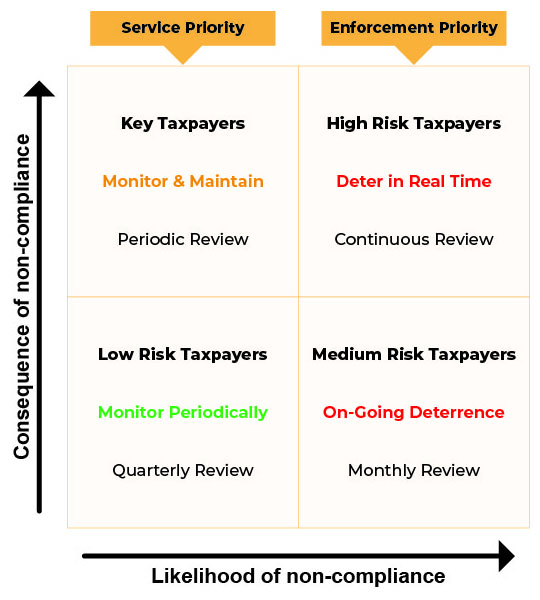
In both cases the risk score or probability of an infraction use a combination of attributes weighted according to the authorities’ subjective priorities. At the same time, the consequence of non-compliance brings in macro-economic factors and assigns weights to high profile entities. These specific industry sectors impact foreign exchange or create a “Systemic Contagion” threat where visible non-compliance, while individually insignificant, easily triggers an industry wide imitation with seismic implications.
Real-world examples of a systemic contagion include
- Multiple country studies have found that 80–90%+ of crypto investors failed to declare taxable activity — even after some domestic exchange reporting.
- The knowledge that VAT filings cannot be reconciled to exports, goods shipping, and intercompany invoices in real-time has led to a whole range of evasion schemes globally – from small traders claiming credit on fake invoices to cartels with sophisticated schemes like Carousel Fraud
These two channels alone have cost treasuries tens to hundreds of billions of dollars a year; the wider global tax gap is measured in the high hundreds of billions annually. That is why treasuries are digitizing and why the World Bank is financing tax-administration modernization with multi-million-dollar loans and grants.
Intelligence-Led Tax Administration
The objective is not to conduct more audits - it is to conduct better audits.
When AI identifies the highest-risk taxpayers, investigators spend less time reviewing compliant businesses and more time pursuing genuine fraud. Legitimate VAT refunds can be processed faster, honest taxpayers experience fewer unnecessary interventions, and scarce enforcement resources deliver greater returns. Predictive scoring does not replace judgement. It tells investigators where to look; people still decide what to do, and taxpayers still have the right to respond.
This intelligence-led approach also supports proactive compliance. Lower-risk taxpayers can receive reminders, educational messages, or requests for clarification before minor errors develop into significant liabilities, improving voluntary compliance while reducing administrative burden.
The Future of Tax Compliance
The future tax authority will not rely solely on tax returns. It will combine fiscalization, e-invoicing, customs, banking, company registries, payroll, property records, crypto reporting, and blockchain intelligence into a unified analytical platform powered by AI.
Fraud detection will become continuous rather than periodic. Risk scores will update automatically as new transactions occur. Investigators will receive explainable recommendations showing precisely why a taxpayer has been prioritized, while machine learning models continually improve from every completed audit.
For governments facing increasing transaction volumes, sophisticated fraud schemes and growing tax gaps, predictive analytics offers more than improved enforcement. It provides a smarter, fairer, and more efficient way to protect public revenue while reducing unnecessary burdens on compliant taxpayers.
The question is no longer whether tax authorities should adopt AI-driven risk scoring. The question is how quickly they can build the integrated data ecosystem needed to make predictive compliance a reality.
The Minority Report era is no longer an aspiration — it is rapidly becoming the defining capability of modern tax administration.
(While Tom Cruise had Precogs, Tax authorities have AI)
Does your business need the Intelligence Edge?
Contact us today to see how our AI-powered analytics can help you level the playing field: detecting anomalies in real time, revealing hidden fraud patterns, and delivering predictive risk insights so you can safeguard your revenue and maintain strong tax compliance. We have a strong tax practice that has helped governments increase compliance revenues by tens of millions.
Ketan Karia – VP, Analytics EMEA Blockchain for VAT
- Share on