




































Using Transaction Pattern Analysis to Detect Crypto Tax Evasion

Suyash Singh – Product Manager - Analytics Solutions
As cryptocurrency adoption continues to expand, tax authorities face increasing challenges identifying taxable activity occurring outside traditional reporting channels. Digital assets can move across multiple wallets, exchanges, blockchains, and jurisdictions, often creating fragmented records that complicate audit and compliance efforts.
At the same time, reporting initiatives such as the OECD's Crypto-Asset Reporting Framework (CARF), DAC8, and expanded exchange reporting requirements are providing tax authorities with unprecedented access to transaction data. The challenge is no longer visibility alone. It is determining which transactions, taxpayers, and behaviors warrant investigative attention.
This shift is transforming crypto tax enforcement into a data intelligence problem. As transaction volumes continue to grow, authorities require scalable methods to identify potentially non-compliant activity and prioritize limited investigative resources. Transaction Pattern Analysis (TPA) has emerged as a critical capability because it focuses on behavioral indicators of risk, enabling authorities to move from reviewing transactions individually to identifying suspicious patterns across entire populations of taxpayers.
Common Cryptocurrency Tax Evasion Patterns
Most cryptocurrency tax evasion schemes do not rely on a single hidden transaction. Instead, they involve sequences of activity designed to obscure ownership, fragment records, or conceal taxable gains.
Common examples include structuring, wallet hopping, exchange hopping, and layering. Structuring divides larger transactions into multiple smaller transfers to avoid scrutiny. Wallet hopping and exchange hopping distribute activity across numerous addresses and platforms, making it more difficult to reconstruct a taxpayer's complete transaction history.
Layering introduces additional intermediary steps intended to create distance between the source of funds and eventual proceeds.
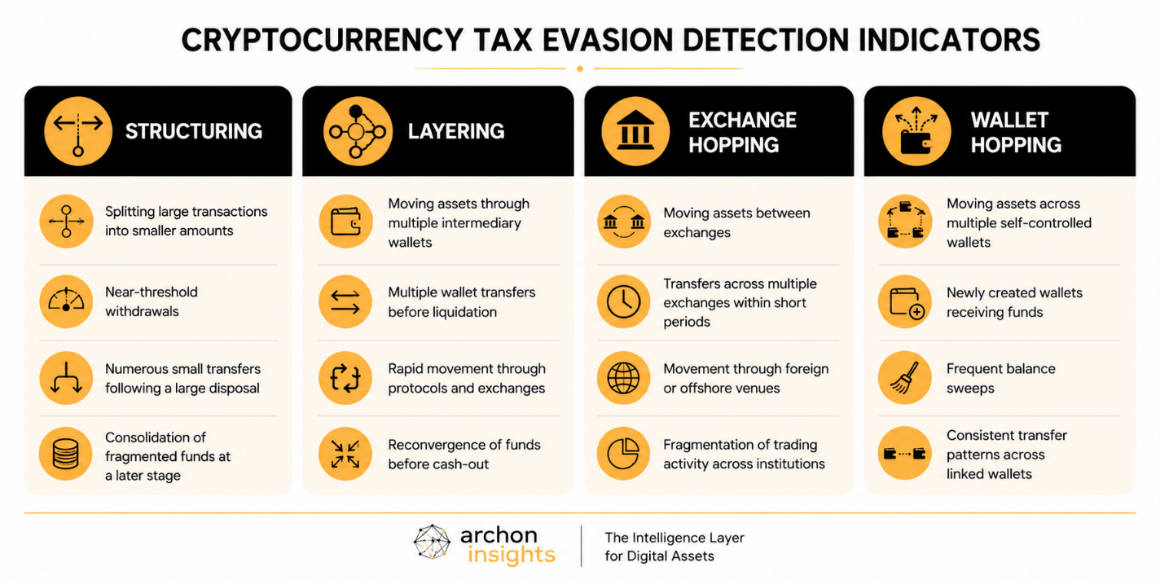
While these techniques differ operationally, they share a common objective: creating transactional complexity that obscures the economic reality of taxable activity. Their significance emerges not from individual transactions, but from the broader patterns they create.
Why Traditional Detection Methods Struggle
Traditional tax audits were designed around centralized financial systems characterized by account statements, regulated intermediaries, and clearly attributable ownership records.
Cryptocurrency activity challenges these assumptions. A single taxpayer may operate across numerous wallets, exchanges, and blockchain networks, generating fragmented records spread across multiple data sources. Cost-basis reconstruction becomes increasingly difficult as assets move between platforms, while the volume of transaction activity can quickly overwhelm manual review processes.
Rule-based monitoring systems face similar limitations. Static thresholds may identify unusually large transactions but frequently miss more sophisticated concealment strategies involving repeated smaller transfers, multiple intermediary wallets, or movement across platforms.
The challenge is not simply scale. It is context. Reviewing individual transactions in isolation often obscures the behavioral patterns that connect them. Effective crypto tax enforcement increasingly requires understanding how transactions relate to one another across time, entities, and platforms.
How Transaction Pattern Analysis Detects Suspicious Activity
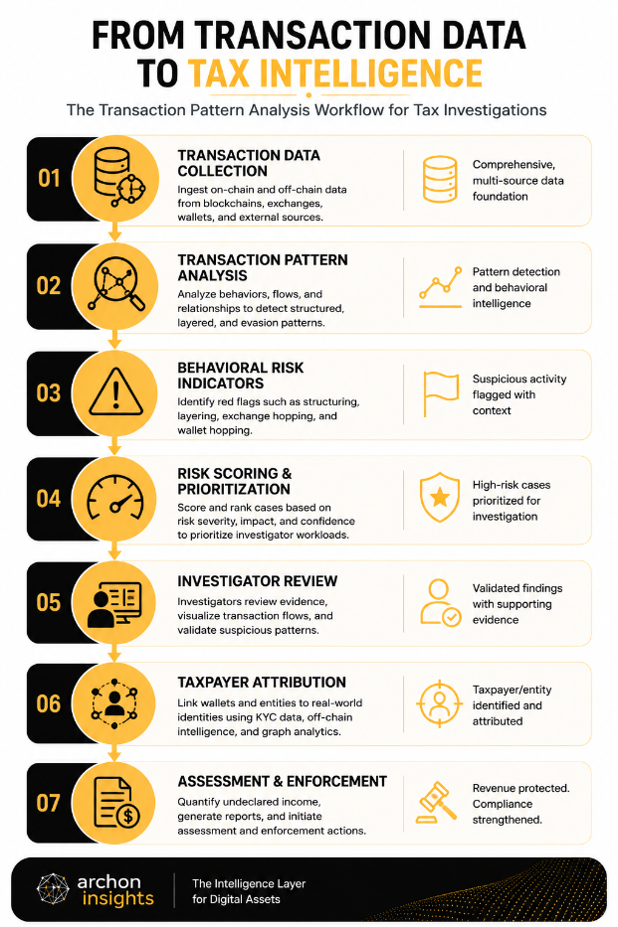
Transaction Pattern Analysis addresses one of the most significant challenges in crypto tax enforcement: identifying meaningful risk signals within vast volumes of fragmented transaction data.
Traditional approaches often focus on individual transactions, wallets, or accounts. Transaction Pattern Analysis instead examines how transactions relate to one another across time, entities, and platforms. The objective is not simply to determine what happened, but to understand whether a sequence of activity exhibits characteristics commonly associated with concealment, underreporting, or other compliance risks.
This distinction is important. A single transfer between wallets is rarely suspicious. A sequence involving dozens of transfers across newly created wallets, multiple exchanges, and cross-chain movements within a short timeframe may warrant closer scrutiny. The risk signal emerges from the pattern rather than from any individual transaction.
How AI Enhances Transaction Pattern Analysis
Transaction Pattern Analysis has traditionally relied on investigator expertise, rules-based monitoring, and manual review. However, the scale and complexity of modern cryptocurrency ecosystems increasingly require analytical techniques capable of identifying patterns across millions of transactions, wallets, and entities.
Artificial Intelligence enhances Transaction Pattern Analysis by enabling authorities to identify behavioral patterns that would be difficult to detect through manual investigation alone. Machine learning models can analyze historical transaction activity and identify similarities to known evasion typologies such as structuring, layering, wallet hopping, and exchange hopping. Graph analytics can uncover hidden relationships between wallets and entities, while anomaly detection techniques help identify transaction patterns that differ significantly from normal taxpayer behavior.
AI also strengthens risk-based enforcement by helping authorities prioritize taxpayers, wallets, and transaction networks based on the likelihood of non-compliance. Rather than replacing investigators, these capabilities enable authorities to focus limited resources on the cases most likely to warrant further review, transforming Transaction Pattern Analysis into a scalable intelligence capability.
Transaction Sequencing
Transaction sequencing examines the order in which events occur.
For example, a taxpayer may dispose of a significant cryptocurrency position and immediately distribute the proceeds across numerous wallets, exchanges, or decentralized protocols. Viewed independently, each transaction may appear legitimate. Viewed collectively, the sequence may resemble known concealment behaviors designed to fragment records or complicate attribution.
Sequencing analysis helps investigators identify relationships between transactions that would otherwise remain hidden.
AI models can identify recurring transaction sequences associated with known evasion behaviors across millions of transactions simultaneously, enabling authorities to detect patterns that would be impractical to uncover through manual review.
Fund Flow Analysis
Fund flow analysis focuses on how value moves throughout a network of wallets, exchanges, financial institutions, and blockchain environments.
The objective is to understand where assets originate, how they move, and where they ultimately converge. While funds may pass through multiple intermediary wallets, they frequently reappear at identifiable off-ramps such as exchange accounts or linked banking channels.
For investigators, this creates a bridge between on-chain activity and potential taxable events.
AI-powered graph analytics can accelerate this process by identifying hidden relationships between wallets, exchanges, and entities, helping investigators reconstruct complex transaction paths more efficiently.
Timing Analysis
Timing often provides important behavioral context.
Rapid movement immediately following a disposal event, bursts of activity occurring within narrow time windows, or repeated transfers before reporting deadlines may indicate efforts to fragment records or reduce visibility.
Timing analysis is particularly valuable because concealment behaviors frequently prioritize speed. Assets are moved quickly through multiple environments before records can be easily reconciled.
Machine learning and anomaly detection techniques can identify unusual timing patterns that differ from normal taxpayer behavior, helping investigators focus on potentially higher-risk activity.
Movement Pattern Analysis
Movement patterns examine how assets travel across the broader digital asset ecosystem.
Examples include wallet hopping across self-controlled addresses, exchange hopping between trading platforms, cross-chain transfers using bridges, and multi-stage transfer chains involving intermediary wallets.
While each activity may have legitimate explanations, repeated use of these behaviors can indicate attempts to create transactional complexity that obscures taxable activity.
AI models can recognize recurring movement patterns across wallets, exchanges, and blockchains, enabling authorities to detect emerging evasion techniques as they evolve.
Pattern Matching Against Known Evasion Typologies
One of the most powerful capabilities of Transaction Pattern Analysis is the ability to compare observed behavior against known tax evasion typologies.
AI significantly improves this process by automatically comparing observed transaction activity against large libraries of known behavioral typologies. Rather than relying solely on predefined rules, machine learning models can identify similarities between current activity and previously observed cases, helping investigators uncover suspicious patterns more efficiently.
Importantly, these patterns do not prove intent and should not be viewed as evidence of non-compliance on their own. Instead, they function as intelligence indicators that help authorities identify cases deserving further review.
This is where Transaction Pattern Analysis delivers its greatest value. Rather than relying on manual review or static thresholds, authorities can screen entire taxpayer populations, identify behavioral outliers, and prioritize cases based on risk. The result is a more scalable, intelligence-driven approach to crypto tax enforcement that directs investigative resources toward the activities most likely to warrant further examination.
Supporting capabilities strengthen this process. AI-powered wallet clustering expands visibility into related addresses, graph analytics reconstructs transaction flows, entity resolution links activity to taxpayers, and machine learning-based risk scoring helps prioritize enforcement action. Together, these capabilities transform suspicious transaction patterns into actionable tax intelligence.
Investigation Scenario: Detecting Undeclared Crypto Gains
Consider a taxpayer who realizes significant cryptocurrency gains during a market rally but reports only a fraction of those gains on their tax return.
Transaction Pattern Analysis identifies several risk indicators following the disposal. Proceeds are divided into numerous smaller transfers, distributed across multiple wallets, and moved through several exchanges within a short period. Individually, these activities may appear legitimate. Collectively, they exhibit characteristics associated with structuring, wallet hopping, and layering.
The analytics do not prove wrongdoing, but they generate a lead.
Investigators then use supporting techniques to expand wallet visibility, reconstruct transaction flows, and establish taxpayer attribution through exchange records, banking information, and tax return data. The resulting investigation enables authorities to quantify previously undeclared gains, reassess tax liabilities, and apply penalties where appropriate.
The investigation begins not with a single suspicious transaction, but with the identification of suspicious behavioral patterns.
Turning Transaction Data into Tax Intelligence
As reporting regimes such as CARF, DAC8, and expanded exchange reporting requirements continue to increase the availability of cryptocurrency transaction data, tax authorities face a new challenge: transforming information into actionable intelligence.
Transaction Pattern Analysis provides a scalable approach to meeting this challenge. By focusing on behavioral indicators rather than isolated transactions, authorities can identify suspicious activity, prioritize investigative resources, and improve the effectiveness of crypto compliance programs.
Achieving this requires more than blockchain visibility alone. Investigators must be able to reconstruct fund flows, identify relationships between entities, detect known evasion typologies, and connect digital asset activity to taxpayers.
Built around AI-powered Transaction Pattern Analysis, Archon Insights helps tax authorities identify suspicious behavioral patterns, trace asset movements across blockchain ecosystems, prioritize high-risk cases, and generate actionable investigative leads from large volumes of digital asset data.
As cryptocurrency ecosystems continue to evolve, effective tax enforcement will increasingly depend on understanding how transactions connect to form behavioral patterns not on reviewing transactions in isolation.
Turning Transaction Data into Tax Intelligence
Tax authorities and compliance teams seeking to operationalize Transaction Pattern Analysis at scale are invited to connect with the team at mLogica. Contact Us to explore how Archon Insights aligns with your specific data environments, risk priorities, and investigative workflows.
Suyash Singh – Product Manager - Analytics Solutions
- Share on