




































VAT Gap Reduction: Best Practices from the EU

Suyash Singh – Product Manager - Analytics Solutions
Each year, European governments budget for revenue they never receive. The European Commission estimates that the EU’s VAT compliance gap reached €128 billion in 2023, reversing gains made during the pandemic. That is 9.5% of the VAT total tax liability, money that could fund hospitals and schools, and that would stop honest businesses from being undercut by competitors that do not pay.
Yet the picture across Europe is far from uniform. Some member states have cut their gaps dramatically while others continue to lose revenue year after year. The difference is not luck. It is a playbook.
The Problem: A Gap That Won't Close Itself
Mind the Right Gap
The VAT gap is not a single problem. The compliance gap is the difference between the VAT that would be collected under full compliance and what tax authorities actually receive: revenue lost to fraud, evasion, and error. The policy gap is revenue governments give up by design, through exemptions and reduced rates. The Commission now reports the two separately, and for good reason: policy choices and enforcement failures need very different fixes.
For tax administrations, the compliance gap is where the real fight is.
Why the Gap Persists
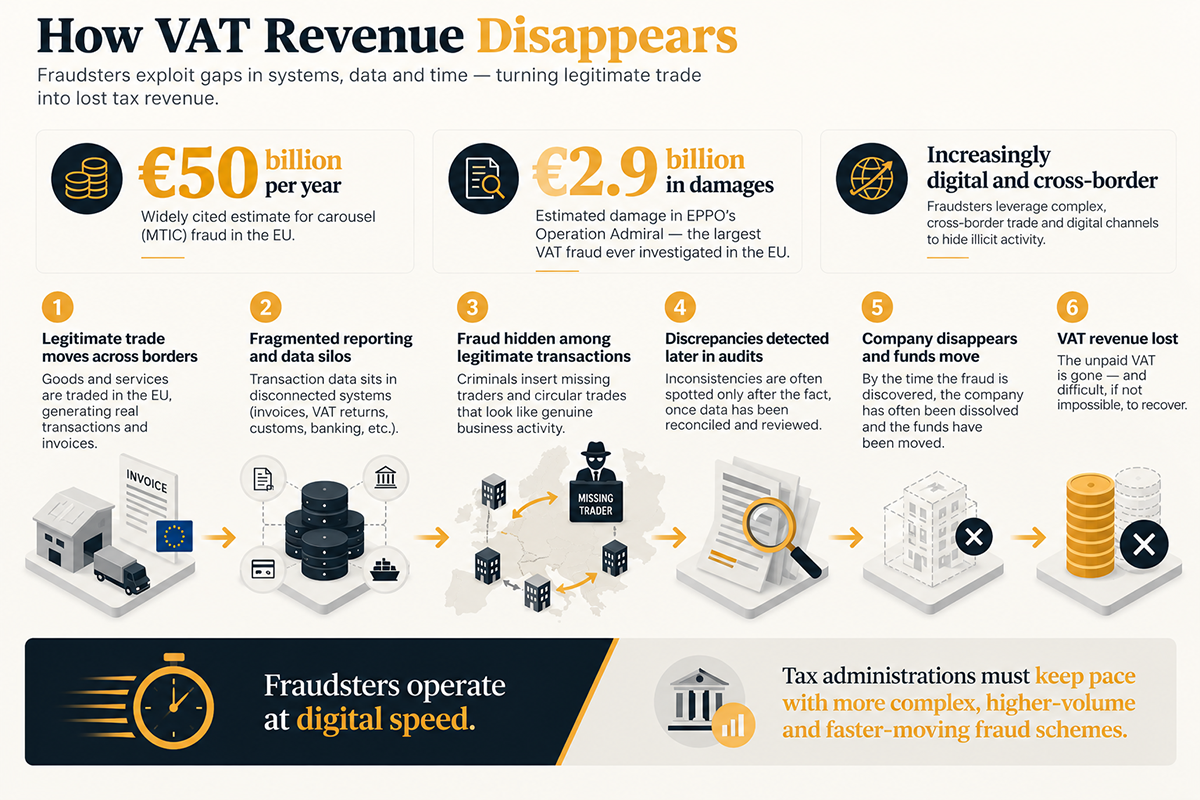
Organized fraud on an industrial scale. Europol has described missing-trader fraud as among the EU’s most profitable crimes. Widely cited estimates, including figures attributed to Europol, put carousel fraud, also known as missing trader intra-Community (MTIC) fraud, at around €50 billion a year in lost tax. That figure is an older estimate, not a current total published on Europol’s MTIC page. The European Public Prosecutor's Office (EPPO) investigation code-named Admiral shows how deep it runs. EPPO calls it the largest VAT fraud ever investigated in the EU, with damages now estimated at €2.9 billion, up from €2.2 billion when the case was announced in November 2022. It began with a suspicion raised by the Portuguese tax authority in Coimbra. On paper, the filings looked in order, which is the point. Carousel fraud is designed to look like legitimate trade.
A digital and cash economy that slips through the net. Cross-border e-commerce, marketplace sellers, and unreported cash sales all exploit systems that were designed for physical businesses trading within clear borders.
Legacy systems and data silos. Many administrations still rely on retrospective audits and fragmented data spread across disconnected systems. By the time a discrepancy is spotted, the company has dissolved, and the revenue has disappeared.
Fraudsters operate at digital speed. Too many tax administrations still operate at paper speed.
The Solution: The EU Playbook
The member states making real progress share four common practices.
1. See Every Transaction as It Happens
Italy is the standout example. In the Commission's 2023 VAT Gap report, Italy cut its VAT gap by 10.7 percentage points and Poland by 7.8 points, among the largest reductions in the EU. The Commission attributed these results to targeted measures around digitalizing tax systems, real-time transaction reporting, and e-invoicing, while also noting temporary pandemic support that was often tied to paying tax. Those gains did not hold: the December 2025 report shows the EU compliance gap widening again in 2023, including in Italy and Poland.
The lesson: digitalization must be comprehensive. Partial or voluntary adoption leaves loopholes that fraudsters will find.
2. Connect the Dots
No single dataset tells the whole story. A VAT return shows declared sales but cannot prove they happened. Linking e-invoices, fiscal receipts, VAT returns, customs declarations, banking data, and company registers builds a 360-degree view of the taxpayer, exposing inconsistencies that no single system would reveal.
3. Let AI Choose the Targets
Static audit rules are quickly learned and gamed. That is why AI is fast becoming standard practice: OECD data shows that 72% of tax administrations in its Forum on Tax Administration inventory use AI, and the most common application, used by three-quarters of them, is detecting tax evasion and fraud. Anomaly detection, network analysis, and predictive risk scoring surface the subtle combinations of signals that indicate fraud, including the circular trading patterns of carousel schemes.
The goal is not more audits. It is better audits.
4. Build Cases That Stand Up in Court
Detection alone recovers nothing. Revenue is recovered, and others are deterred, only when cases succeed. That requires explainable, court-admissible evidence, not black-box alerts that judges are rightly wary of.
Why Now? ViDA Raises the Stakes
The EU adopted the VAT in the Digital Age (ViDA) package on 11 March 2025. From 1 July 2030, digital reporting requirements based on e-invoicing will apply to intra-EU transactions. By 1 January 2035, member states that already run a domestic real-time reporting system must align it with the EU model.
ViDA effectively makes Practice 1 law. But it will also flood tax administrations with data. Without the capability to integrate, analyze, and act on that data, authorities risk becoming data-rich but still revenue-poor.
From Playbook to Practice: CAP*M
Proven in a European country
A European country aligning its VAT system with EU standards shows what happens when all four practices come together.
Its electronic fiscalization system, powered by CAP*M, became mandatory in January 2022 and now processes over 10 million transactions every day. The results speak for themselves:
- VAT revenue increased by 14% in real terms, and 70% of the government's goals for tackling the grey economy have been met.
- In 2023, mLogica's fraud management systems identified 8,640 non-compliant taxpayers, each with supporting evidence.
- Audit and recovery ratios now exceed 60%.
- The prosecution rate for AI-detected evasion is over 90%.
- VAT now forms the largest share of net new tax revenue.
In 2025, the World Bank approved an additional €27.25 million to modernize tax administration in that country, including further digitization.
How CAP*M Delivers the Playbook
mLogica's CAP*M Complex Events Analytics Platform maps directly to each practice:
| Best Practice | CAP*M Capability |
|---|---|
| Real-time capture | Ultra-high-speed ingestion of transaction data at petabyte scale |
| Integrated taxpayer view | Blending of internal, third-party, and external data into a single version of the truth |
| AI-led detection | Anomaly detection, network analysis, and predictive risk scoring |
| Enforcement with evidence | Actionable alerts backed by court-admissible evidence |
Modernization Without the Risk
For many governments, the biggest barrier to modernization is not cost. It is the risk of a visible transformation failure. CAP*M integrates with the systems tax authorities already use, delivering intelligence without a disruptive rip-and-replace.
The Bottom Line
Europe's leaders have shown that the VAT gap can be closed. The playbook is proven, and ViDA's deadline makes acting on it urgent.
The question is no longer what works. It is how quickly you can put it to work.
Give Your Administration the Intelligence Edge
Contact us today for a free assessment of your tax analytics needs. See how mLogica's AI-powered analytics can help you detect anomalies in real time, uncover hidden fraud networks, and turn data into recovered revenue.
References
- European Commission, Taxation and Customs Union. VAT Gap in Europe – Report 2025 (Mind the Gap report series). 11 December 2025.
https://taxation-customs.ec.europa.eu/taxation/vat/fight-against-vat-fraud/mind-gap-report_en - European Commission, Taxation and Customs Union. VAT Gap.
https://taxation-customs.ec.europa.eu/vat-gap_en - European Public Prosecutor's Office (EPPO). Operation Admiral: EPPO uncovers organized crime groups responsible for VAT fraud estimated at €2.2 billion. November 2022.
https://www.eppo.europa.eu/en/media/news/operation-admiral-eppo-uncovers-organised-crime-groups-responsible-vat-fraud-estimated - European Public Prosecutor's Office (EPPO). Investigation Admiral 2.0: Europe's biggest VAT fraud with links to organized crime.
https://www.eppo.europa.eu/en/node/948 - Organized Crime and Corruption Reporting Project (OCCRP). EU Uncovers Near-Global €2.2 Billion Tax Fraud Scheme. November 2022.
https://www.occrp.org/en/daily/17103-eu-uncovers-near-global-2-2-billion-tax-fraud-scheme - European Commission. Member States made progress in VAT compliance in 2021, though losses remain considerable. 24 October 2023.
https://cyprus.representation.ec.europa.eu/news/member-states-made-progress-vat-compliance-2021-though-losses-remain-considerable-2023-10-24_en - OECD. Tax Administration Digitalization and Digital Transformation Initiatives. OECD Publishing, Paris.
https://www.oecd.org/en/publications/tax-administration-digitalisation-and-digital-transformation-initiatives_c076d776-en/full-report/component-10.html - European Commission, Taxation and Customs Union. VAT in the Digital Age (ViDA).
https://taxation-customs.ec.europa.eu/taxation/vat/vat-digital-age-vida_en - Council of the European Union. Taxation: Council adopts VAT in the digital age package. Press release, 11 March 2025.
https://www.consilium.europa.eu/en/press/press-releases/2025/03/11/taxation-council-adopts-vat-in-the-digital-age-package/ - World Bank. World Bank Supports a European Country’s Further Tax Administration Reform. Press release, 1 August 2025.
[public URL withheld the release names the jurisdiction]
Suyash Singh – Product Manager - Analytics Solutions
- Share on