
































When Data Cannot Fail

The mLogica Migration Team
When data is critical to customer success, AWS Transform's agentic AI service (ATX) and STAR*M's specialized agents work together to automate the database modernization journey end to end.
The Hard Part Is Not Data Movement Alone
Database modernization is accelerating, but for many complex enterprise estates the hardest work is not data movement alone. Cloud-native migration services and AI can automate portions of discovery, assessment, planning, schema conversion, and data transfer. The more difficult problem is preserving and transforming the behavior embedded around the data: stored procedures, business rules, transaction semantics, platform-specific SQL, data relationships, application dependencies, and performance requirements.
A target database can be created and populated without proving that the modernized system will behave as required in production. The relevant standard is whether the transformed workload preserves or intentionally changes business behavior according to the target design, reconciles against defined source outcomes, meets required service levels, and produces enough traceable evidence to support a production decision. That is the execution boundary mLogica is addressing through the integration of STAR*M with AWS ATX.
What Complexity Looks Like
Consider a representative enterprise database estate built on Sybase ASE, IBM Db2, Microsoft SQL Server, or a combination of these platforms. It may contain thousands of stored procedures, packages, functions, triggers, cross-database links, platform-specific SQL, and undocumented business rules embedded in Transact-SQL, SQL PL, or other proprietary extensions. No single developer fully understands the entire workload. Moving the tables to Amazon Aurora PostgreSQL addresses only one part of the program. Procedural code and dependencies must be discovered, analyzed, mapped, and transformed. Transaction behavior must remain intact; results must reconcile with the source, and the target environment must meet production performance and service-level requirements.
What mLogica Built Inside AWS Transform
This post is for AWS account teams, solution architects, and delivery partners evaluating complex, application-coupled database modernization. It also gives enterprise technology leaders a concrete view of how AWS Transform and mLogica STAR*M coordinate specialized agents, controlled transformation, and validation.
mLogica integrated STAR*M, its database modernization platform, with AWS Transform so that specialized database capabilities participate directly in the AWS Transform operating model. STAR*M extends the workflow into heterogeneous, application-coupled source and target patterns involving platforms such as Sybase, SQL Server, Oracle, Teradata, and Db2. Within the current reference architecture, the integration complements the Full Stack Windows Modernization track in AWS Transform.
The integration does not displace AWS-native migration services. It gives AWS teams and delivery partners a specialized execution path when procedural logic, semantic dependencies, application coupling, reconciliation, or performance requirements demand more than schema translation and data transfer.
Together, assessment, extraction, transformation, deployment, and validation form the STAR*M database modernization lifecycle. We refer to this defined sequence below as the STAR*M lifecycle.
How the Workflow Operates
The integration follows the order in which modernization decisions must be made. Each stage produces artifacts for the next stage and preserves the information needed for review, exception handling, and approval.
The reference architecture shows the sequence from the user request at the upper left through agent discovery, ATX invocation, mLogica orchestration, sub-agent execution, artifact persistence, target deployment, validation, and human sign-off. The principal arrows mark request initiation, agent discovery, Agent-to-Agent invocation, artifact reads and writes, source extraction, and deployment to Amazon Aurora PostgreSQL.
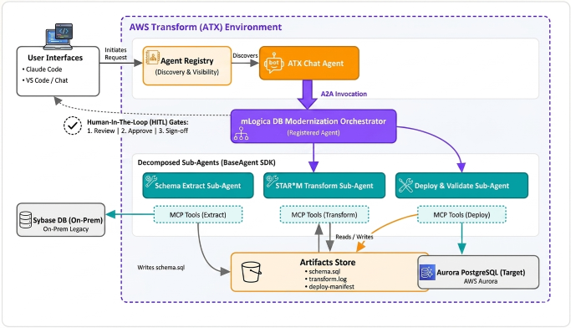
STAR*M integration with AWS Transform reference architecture
The operating flow follows five steps.
- Initiate and discover. A user begins in the AWS Transform environment. The Agent Registry discovers the registered mLogica database modernization capability, and the ATX Chat Agent invokes the orchestrator through Agent-to-Agent communication.
- Assess and extract. The workflow characterizes the estate, identifies complexity, and captures schemas, procedural logic, dependencies, and other source objects that must be understood before transformation.
- Transform. The STAR*M Transform sub-agent applies the qualified source-to-target rules and produces traceable transformation outputs for review and deployment.
- Persist artifacts. The artifacts store retains schema definitions, transformation logs, deployment manifests, and related records so that the workflow does not depend on transient agent responses.
- Deploy, validate, and approve. The deployment and validation functions move the transformed workload to the AWS target, test it against defined acceptance criteria, and preserve human review, approval, and sign-off at the production decision gates.
How AI Works in the Workflow
AWS Transform and STAR*M apply AI to different parts of the same workflow. The ATX Chat Agent gives teams a conversational entry point and coordinates agent invocation. The mLogica orchestrator decomposes the request into specialized database tasks. STAR*M then uses domain-specific Small Language Models and specialized intelligence to analyze procedural SQL, dependencies, and transformation patterns within a governed execution pipeline.
The important distinction is what happens after AI identifies or proposes a transformation. STAR*M executes qualified rules through deterministic, version-controlled processes, records the resulting artifacts, and connects those outputs to validation. The same approved inputs, rules, and software versions produce repeatable results. Human reviewers remain responsible for exceptions, design choices, and release of approval.
This division of labor makes AI useful without treating generated output as production evidence. AI accelerates discovery and analysis. Deterministic execution controls the transformation. Validation establishes whether the target behaves as required.
Why the Integration Matters
AWS provides the cloud platform, target services, modernization ecosystem, and agentic foundation. mLogica provides specialized database transformation and validation inside that operating model. STAR*M therefore fits into AWS-led and partner-led programs without requiring customers or global systems of integrators to replace the architecture, delivery model, or governance already surrounding the workload.
For standardized patterns, AWS-native services remain at the right starting point. When a database carries extensive procedural logic, heterogeneous dependencies, or demanding reconciliation and performance requirements, the STAR*M integration extends the same modernization environment with deeper database execution.
Business Impact
| AWS Teams | Delivery Partners and GSIs | Enterprise Customers |
|---|---|---|
| Extends AWS Transform coverage for complex database patterns and creates a direct path from heterogeneous estates to AWS target services. Specialized execution remains connected to the agentic modernization environment instead of becoming a separate point-tool workflow. | Reduces custom engineering and repetitive remediation on qualified source-to-target patterns while keeping specialists focused on exceptions and architecture decisions. A reusable lifecycle improves delivery of leverage across a portfolio. | Provides a controlled route from estate assessment to production readiness with fewer manual handoffs and a retained record of transformation and validation of artifacts. Business behavior, reconciliation, and performance remain central across repeated workloads. |
What Success Looks Like
Success is not measured only by migration speed, or the volume of code an AI model generates. The target workload must behave as intended, reconcile against defined outcomes, meet production requirements, and carry enough traceable evidence for an accountable release decision.
AWS Transform supplies the agentic modernization foundation and cloud scale. mLogica STAR*M adds specialized database depth for complex workloads. The integration connects the STAR*M lifecycle to a repeatable AWS operating model while preserving human control where design, risk, and production approval require it.
Next Step
Have a complex database candidate? AWS teams and delivery partners can schedule a technical working session with mLogica to qualify for the workload, review the reference architecture, and request a demonstration. Enterprise customers can request an initial database assessment through mLogica Contact Us.
AI accelerates the work. AWS provides the agentic foundation. mLogica brings specialized transformation, deterministic execution, and validation.
The mLogica Migration Team
- Share on