



































Why Batch Analytics Can No Longer Fully Support Modern Operational Decision-Making

Kapil Maggon – Senior Solutions Architect– mLogica Analytics
For decades, batch analytics served as the backbone of enterprise reporting. Nightly data refreshes, weekly summaries, and monthly reconciliations provided the structured insights needed for strategic planning and periodic reviews. This approach worked well in relatively stable business environments with predictable data volumes and slower decision cycles.
However, the nature of business operations has fundamentally changed. Organizations now generate massive streams of high-velocity data from sensors, transactions, IoT devices, networks, and customer interactions. In this environment, traditional batch processing increasingly falls short for operational decision-making.
The Limitations of Batch Analytics
Batch systems process data in scheduled, discrete jobs often with significant delays between data creation and insight availability. While effective for historical trend analysis and large-scale offline reporting, they struggle with several realities of today’s operations:
- High-velocity event streams: Data arrives continuously and must be acted upon quickly.
- Need for immediate context: Operational decisions require not just raw data, but enriched events with business meaning (identifiers, classifications, life cycles, relationships, and descriptive details).
- Data quality at scale: Ensuring completeness, consistency, accuracy, and timeliness become difficult when processing occurs long after events occur.
- Real-world use cases: Fraud detection, supply chain disruptions, customer experience issues, network anomalies, and financial exceptions all demand rapid detection and response.
Waiting hours or days for processed results creates blind spots. By the time insights become available, the opportunity to act effectively may have passed.
The Rise of Complex Event Analytics (CEA)
Complex Event Analytics addresses these challenges by focusing on the continuous capture, processing, and enrichment of high-volume, high-velocity event streams. Rather than treating data as static batches, the CEA platform views business activity as sequences of interrelated events that can be analyzed in context as they occur.
Key characteristics of effective CEA include:
- Event-centric design: Centered on structured events that carry a rich business context.
- Layered architecture: Typically organized into loosely coupled stages such as Capture, Processing, Persistence, Enrichment, Delivery, and Utilization. These layers operate asynchronously to support extreme scalability and resilience.
- Emphasis on data veracity: Automated validation, quality scoring, and governance applied at scale.
- Support for both real-time and historical analysis: Near real-time processing for immediate action, combined with persistent storage for deeper investigation.
- AI and analytics readiness: Enriched events that feed advanced techniques including anomaly detection, predictive modeling, Causal AI, and Agentic AI.
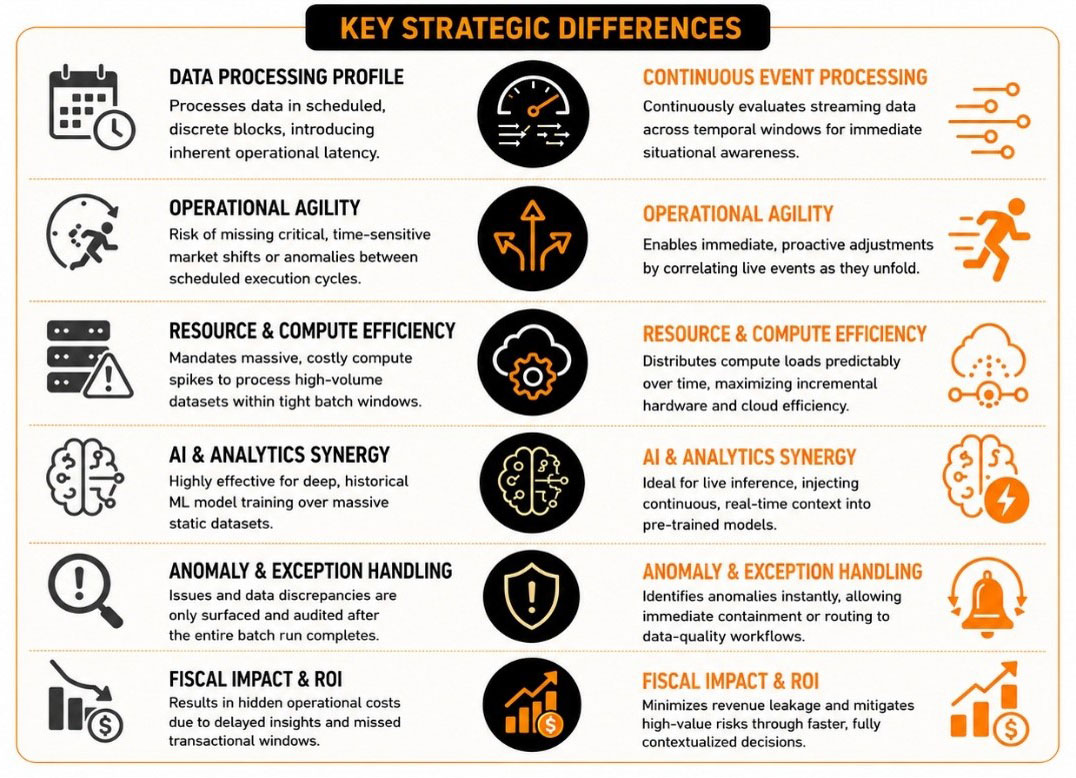
This approach enables organizations to reduce the gap between event occurrence and actionable insight often from trillions of raw events down to meaningful intelligence in seconds. The architectural difference lies in how data flows. Batch systems collect information, hold it temporarily, then transfer it in bulk at predetermined times. Streaming architectures, the foundation of real-time Complex Event Analytics, move data continuously through models and event-driven processing.
Enterprise Summary: Batch Processing V/S Real Time Complex Event Analytics (CEA)
mLogica CAP*M CEA in Practice
mLogica CAP*M Complex Event Analytics Fabric is a purpose-built solution designed for these demanding environments. It provides a complete event-to-insight pipe with BatchLine with a strong focus on quality, scalability, and business relevance.
Its six-layer architecture (Capture → Processing → Persistence → Enrichment → Delivery → Utilization) allows components to scale independently while maintaining data consistency. Notable technical elements include:
- Rich business context: Events are enhanced with standardized dimensions identifiers, classifications (including life cycles), references, and elaborations making them immediately usable for analysis.
- Data quality and governance: Automated validation and enrichment processes applied in both near real-time and batch-like post-processing modes.
- Flexible persistence: Support for high-speed ingestion into structured repositories, with options for distributed in-memory stores and traditional columnar databases.
- Advanced processing: Near real-time trending, scoring, and alarming capabilities.
- Utilization layer: Framework for multidimensional analysis, machine learning, and AI workloads, with bi-directional feedback of model outputs back into the event fabric.
- Deployment flexibility: Works across cloud, on-premises, hybrid, and multi-cloud environments.
CAP*M is particularly relevant for industries that generate large-scale event data, such as telecommunications, financial services, logistics, smart manufacturing, and utilities.

Implications for Enterprise Data Strategy
The shift from pure batch analytics to Complex Event Analytics does not mean batch processing is obsolete. Batch methods remain valuable for deep historical analysis, model training, and periodic reporting. The more pressing need is for platforms that can handle both high-velocity streaming and robust historical capabilities within a unified architecture.
Organizations that continue relying exclusively on traditional batch systems for operational decisions risk slower response times, reduced data trustworthiness, and competitive disadvantages. A hybrid approach combining the strengths of batch where appropriate with real-time Complex Event Analytics for operational agility appears to be the more sustainable path forward.
Ready to move beyond batch limitations? Discover how CAP*M can modernize your event analytics strategy.
Kapil Maggon – Senior Solutions Architect– mLogica Analytics
- Share on