


































GenAI Transformation Controls
The mLogica Migration Team
How to operationalize Agentic AI in mainframe modernization without compromising security, compliance, or equivalence
In the first blog, we laid out the core premise: GenAI (and increasingly Agentic AI) can compress discovery and accelerate change, but production modernization still demands deterministic execution and continuous proof. In other words, the modernization program must move fast and remain auditable, safe to cut over, and resilient across real-world runtime dependencies.
This follow-on blog answers the next practical question executives and engineering leaders ask immediately after they accept that premise:
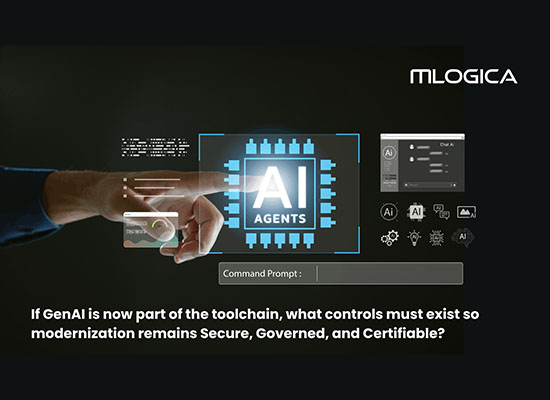
If GenAI is now part of the toolchain, what controls must exist so modernization remains Secure, Governed, and Certifiable?
The following is a control framework mLogica uses to turn AI acceleration into repeatable outcomes, especially in regulated environments where “it seems correct” is not an acceptable standard.
Why controls matter more in mainframe modernization
Agentic AI changes the shape of risk. It does not merely suggest code; it can traverse repositories, generate transformation artifacts, and iterate on fixes. That is powerful, and it expands the surface area for:
- IP and data exposure (source, copybooks, JCL, test data, configuration, runbooks)
- Uncontrolled variability (prompt drift, model updates, non-deterministic outputs)
- Hidden failure modes (semantic divergence, batch timing issues, transaction-processing parity gaps)
- Compliance gaps (no traceable rationale, incomplete approvals, missing evidence packs)
This is why “AI-first” modernization fails when it is treated as a creative workflow. Modernization is an engineering discipline. The controls below make it one.
IP and security controls that match production reality
Mainframe portfolios include crown-jewel logic. The objective is straightforward: use AI without leaking code, context, credentials, or operational procedures.
mLogica’s approach is to apply enterprise-grade protections consistently across the AI data plane:
- Data residency and tenant isolation aligned to regulatory and contractual requirements
- Least-privilege access for both humans and agents (repo scopes, tool permissions, environment boundaries)
- Secrets hygiene (no credential exposure in prompts, code comments, logs, or generated scripts)
- Retention and logging policies that preserve required audit trails while avoiding unnecessary data persistence
- Sanitization/redaction rules for prompts and retrieved context where appropriate
A simple standard helps: If an artifact should not be emailed, it should not be prompt-able without controls.
Prompt governance as a first-class engineering asset
In modernization, prompts are not “helpful text.” They are operational instructions that influence code transformation decisions. That makes prompt governance non-negotiable.
Treat prompts as governed assets:
- Prompt versioning and change control (“prompt-as-code”)
- Approved templates for common tasks (documentation, refactoring guidance, test scaffolding, interface inventory)
- Guardrails and constraints that reduce ambiguity (target runtime assumptions, language standards, naming conventions, test requirements)
- Grounding in authoritative evidence, using a curated knowledge base rather than ad hoc context
- Prompt testing against representative workloads to detect regressions caused by prompt drift
This is where an Automated Knowledge Base (AKB) becomes decisive: it gives GenAI/agents a controlled, traceable evidence source, so outputs remain explainable and defensible, not speculative.
A critical and often underestimated challenge in production use of GenAI is output drift: the same prompt producing meaningfully different outputs across three dimensions. First, instance-level drift, non-determinism within a single model version means repeated executions of the same prompt can yield structurally or semantically different results. Second, model-version drift, provider updates to the same model (even minor ones) can shift behavior, tone, or structure of outputs without notice. Third, cross-model drift, different models respond differently to identical prompts, which matters when organizations use multiple providers or migrate between them. Managing drift requires prompt regression testing (running versioned prompts against a golden test set after any model or prompt change), output schema validation (asserting structural constraints on generated artifacts rather than accepting free-form text), temperature and sampling controls (reducing randomness for transformation tasks where consistency is paramount), and model pinning policies (explicit governance over when and how a team may move to a new model version). These controls belong in the same governance layer as code, not as afterthoughts once drift is discovered in production.
Human-in-the-loop design that is explicit, not aspirational
Human-in-the-loop (HITL) cannot be a slogan. It must be an engineered workflow with defined decision points, accountability, and evidence.
mLogica structures HITL around promotion gates:
- SME validation gates for recovered rules, workflow narratives, and behavioral assumptions
- Engineering review gates for generated refactoring artifacts, mappings, and interface changes
- Security/compliance gates for data handling, access scopes, and evidence completeness
- Release authority gates for promotion into integration and production-like environments
For agentic workflows, the HITL pattern must also include permissioned action boundaries, what an agent can read, what it can write, what it can execute, and what always requires approval. This is how you scale AI assistance without delegating accountability.
Practically, this means designing the hybrid execution loop with intentionality: deterministic steps handle what is rule-bound and repeatable (parsing, transformation, test execution); GenAI steps handle what is ambiguous or discovery-intensive (rule inference, documentation synthesis, test case generation); and human steps handle what requires judgment, accountability, or sign-off.
Keeping these lanes explicit is also how you manage the trade-off between agility, accuracy, and cost. Broad use of GenAI on deterministic tasks inflates token spend without improving outcomes. Tight HITL gates on low-risk, high-volume steps create bottlenecks. The right calibration depends on risk classification: high-criticality business logic demands tighter human gates; boilerplate scaffolding tolerates more automation. mLogica applies this tiered model across the modernization pipeline so that acceleration and control reinforce each other rather than compete.
Regression validation and equivalence proof as the system of truth
The most expensive modernization failures are not syntax errors. They are subtle semantic divergences that emerge in edge cases: rounding rules, record layouts, sort order, batch windows, transaction concurrency, or data migration defects.
That is why validation must be continuous and industrialized:
- Automated regression suites that run on every change set
- Equivalence testing tied to business outcomes, not just code coverage
- Batch and transaction-processing parity validation (timing, throughput, restart behavior, error handling)
- Data reconciliation during migration (schema evolution, referential integrity, performance characteristics)
- Parallel Run where legacy and modernized paths execute side-by-side and outputs are reconciled
Crucially, deterministic transformation and automated validation must work together. AI may help create test scaffolding faster, but tests, reconciliations, and parity gates decide what ships.
The missing layer in most programs: the evidence spine
When modernization is audited, formally or informally, leaders need to answer four questions:
- What changed?
- Why did it change?
- How was it tested and proven equivalent?
- Who approved it, and under which controls?
mLogica builds an evidence spine that links: prompts → retrieved context → generated artifacts → deterministic transformations → test runs → reconciliations → approvals → release packages.
This is what turns “AI-assisted” into audit-ready modernization, especially across mixed-language estates (COBOL plus Assembler/Easytrieve/PL/I), runtime dependencies, and data migration.
Which modernization patterns benefit most from GenAI, and where to prioritize
Not all modernization patterns are equally positioned to benefit from GenAI, and investment decisions should reflect that. mLogica currently pursues three primary patterns, each suited to a different scope of transformation and each absorbing GenAI in a distinct way.
Re-factor (Code to Code) is the highest-volume pattern and the one where deterministic pipelines already carry most of the load. GenAI adds value at the margins: handling edge-case constructs that rules-based engines mishandle, generating inline commentary, and producing candidate refactoring suggestions for SME review. The ratio of deterministic-to-AI work here should be heavily weighted toward deterministic. Cost efficiency is highest; risk is lowest. This is where volume throughput is maximized.
Re-architecture (Code to Spec to Code) preserves functionality but restructures the design. This is where GenAI contributes most meaningfully to the specification layer: recovering undocumented business logic, synthesizing interface contracts, and drafting architectural narratives from code that has never had documentation. Human review of the generated spec is non-negotiable before code regeneration begins, because errors in the spec compound into errors in the output. The hybrid loop is most active here, and HITL investment yields the highest return relative to risk.
Re-imagine (Process Re-engineering) goes furthest: it challenges not just the implementation but the process model itself. GenAI assists in modeling current-state processes from code and documentation, identifying automation and consolidation opportunities, and generating target-state specifications for reimagined workflows. The risk profile is highest here because changes to process logic, not just technology, require business ownership and extensive validation. mLogica applies Re-imagine selectively, typically where the legacy process is provably inefficient, not merely because the technology is old. Controls for this pattern must include explicit business sign-off at the re-modeling stage, not just at code delivery.
In practice, most programs run all three patterns in parallel across different portfolio segments. The governance implication is that controls, HITL gates, and evidence requirements must be calibrated per pattern, not applied uniformly. A single governance model that treats Re-factor the same as Re-imagine will either over-constrain throughput or under-protect the highest-risk decisions.
How mLogica operationalizes these controls in practice
mLogica’s modernization factory combines:
- Deterministic modernization pipelines (repeatable refactoring and regeneration)
- A governed knowledge layer (AKB) for traceability and explainability
- Integrated services to enforce real-world sequencing, governance, remediation, and readiness
- GenAI and Agentic AI accelerators embedded within guardrails, not outside them
- Continuous validation to prove parity and reduce cutover risk
The result is practical: modernization that moves faster, with stronger proof, and fewer late-stage surprises.
The next step
If GenAI is in your modernization plan, the control question is unavoidable: are your AI-enabled changes traceable, testable, and certifiable, or merely fast?
mLogica can help you assess your current transformation controls, define a governed prompt and agent model, and implement regression and equivalence validation that produces audit-ready evidence, so AI acceleration becomes a business advantage, not a new risk category.

The mLogica Migration Team
- Share on